 In this area
Arashiyama
Suiran, a Luxury Collection Hotel, Kyoto
9.2· 172 reviews
approx. from£1,010 / nightSee prices
The Kyoto issue
A scenic west-Kyoto district where the best hour is dawn, the core pleasures are temples, tofu and river light, and the crowds thin just as the mountains begin to glow.
By Haruka NishimuraTemple by temple, gardens to Nishijin looms
Twenty minutes west of central Kyoto, the JR Sagano Line delivers you to a place that still seems to be operating on older clocks. Arashiyama is all river sheen, temple gates, and the kind of bamboo path that can make even a jaded visitor lower their voice. Get here before 8am and the district feels like a private stage set: the Katsura River lying flat under the bridge, shop shutters still down, the bamboo creaking faintly overhead. Come later and you will understand why the same street can feel both enchanted and slightly overbooked. It is a neighbourhood built for daylight, for walking, and for the patient pleasures of Kyoto at its most scenic.
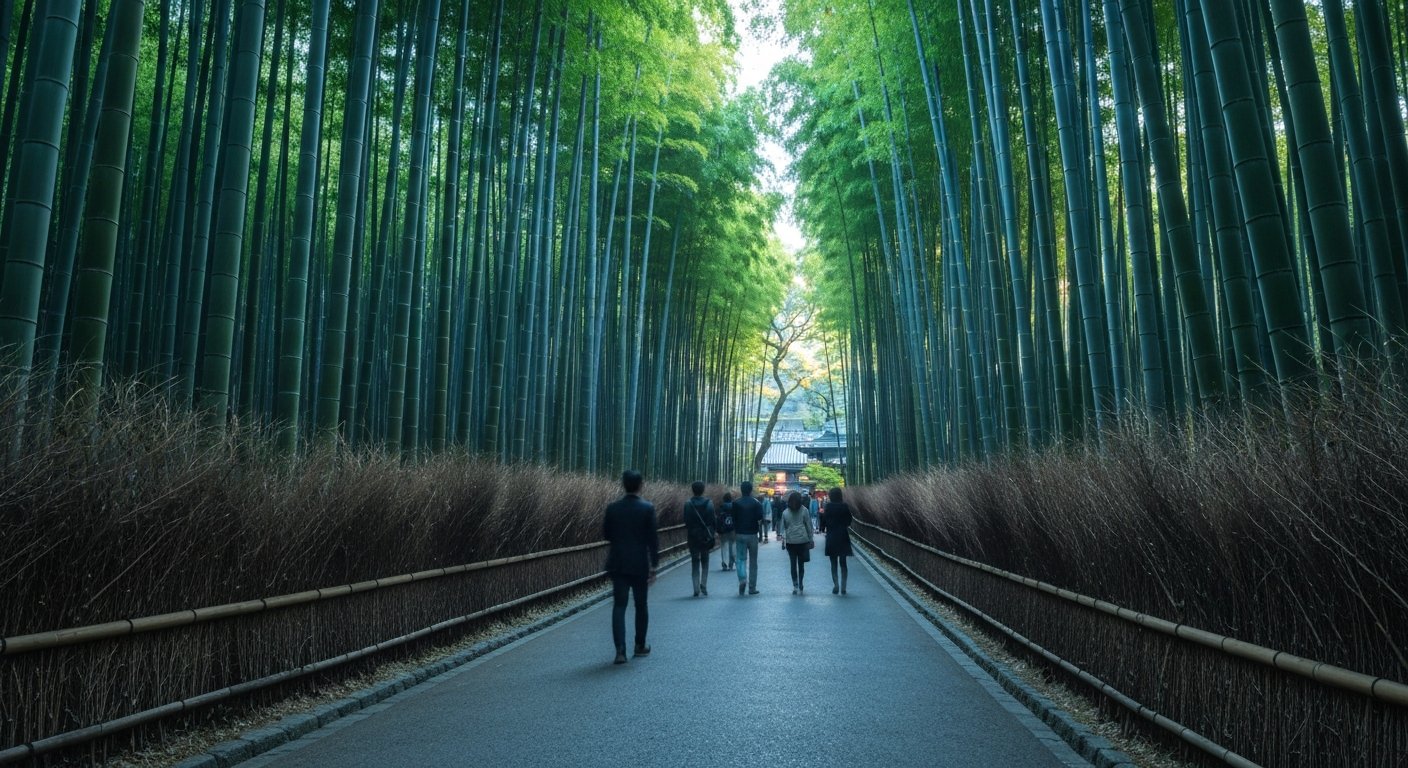
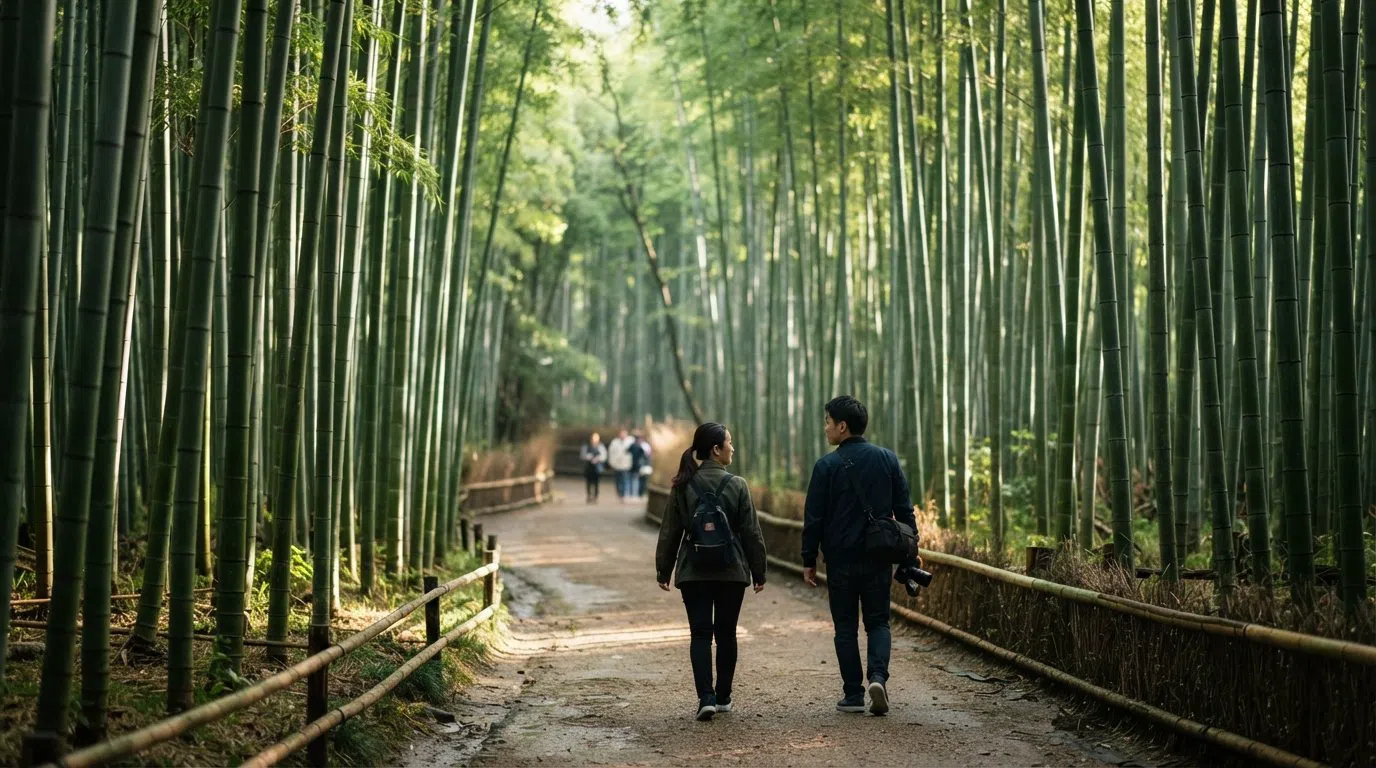
Arashiyama’s first image is the one everyone has already seen, but it still lands when you meet it in person: the Arashiyama Bamboo Grove, a roughly 400-metre path running north from Tenryu-ji’s back gate toward Okochi-Sanso Villa. It is free, open 24 hours, and flat, which sounds accommodating until late morning, when the path becomes a gentle bottleneck of phones held aloft and people trying to step around one another without looking rude. The difference between wonder and scrum is timing. Before 8am, the grove has that rare quality of being both famous and empty.
Water gives Arashiyama its second signature. Togetsukyo Bridge, the “Moon Crossing Bridge,” spans the Katsura River at the centre of the district, with Mount Arashiyama rising wooded and steep behind it. It is the postcard view in cherry blossom and autumn maple seasons, when the hillsides turn pink or flame-red, though even on an ordinary morning the river has a calmness that settles the whole scene. Stand here at dusk and the place sheds its daytime urgency; the coaches leave, the street quiets, and the bridge belongs again to the river and the mountain.
Beyond the headline sights, Arashiyama is a temple town that happens to have excellent scenery. Tenryu-ji, a UNESCO World Heritage site and the first-ranked of Kyoto’s five great Zen temples, anchors the centre. Its Sogen-chi pond garden uses the mountains as borrowed scenery with the confidence of a place that has been doing this for centuries. North of it, the district turns more contemplative, with moss temples climbing into the Sagano hills and the occasional comic relief of a monkey park or a scenic train. The mood is reverent, but not solemn in a stiff way. Kyoto here is looking at trees, not performing for them.
Live prices from our booking partners.
Free cancellation on many rooms. We may earn a commission when you book.
Arashiyama’s most persistent edible identity is tofu, and the district is happy to make a whole lunch out of that fact. At the refined end, Shoraian sits tucked on the wooded south bank above the river, serving tofu-kaiseki with gorge views and the sort of reservation policy that politely implies you should have planned ahead. Courses revolve around yudofu, yuba and seasonal small dishes, and the setting does a great deal of the work: a meal here is as much about the sound of the water below as what arrives on the tray.
A little less formal, but no less rooted in place, Yudofu Sagano does classic simmered-tofu sets in a garden setting. It is the sort of lunch that suits Arashiyama’s pace: warm, restrained, and not in a hurry to impress you. Saga Tofu Ine, near the main street, is the more approachable version of the same tradition, with yuba and hirosu lunches at fair prices. It is the kind of place that reminds you tofu in Kyoto is not a health concession; it is a local language.
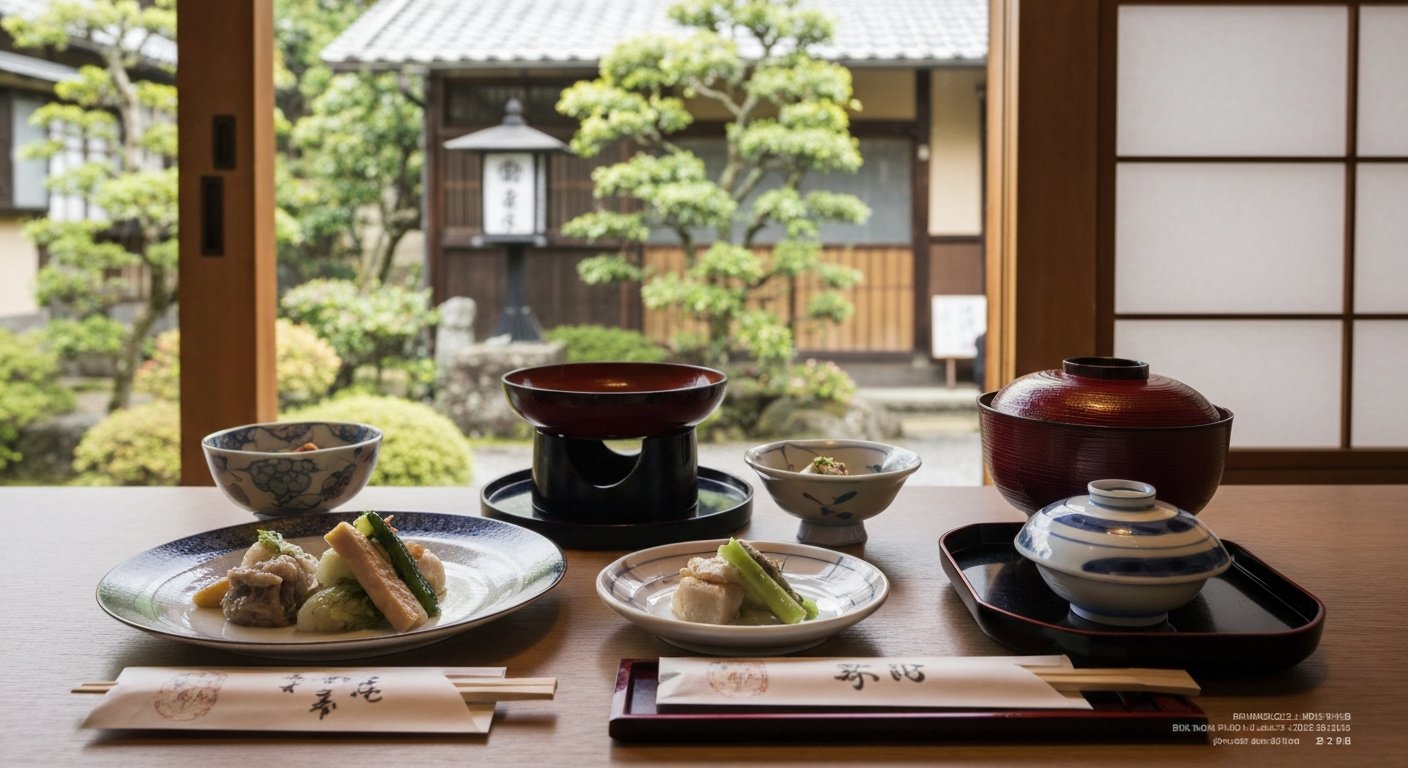
The most soulful meal in the district may be the one hidden inside the temple grounds themselves. Shigetsu, Tenryu-ji’s own restaurant, serves shojin-ryori — Zen Buddhist vegetarian cuisine — in Snow, Moon and Flower courses, priced from ¥3,800 to ¥9,000, and it carries a Bib Gourmand in the 2025 Michelin Guide. The setting is as quiet as the food is considered. You do not come here to be dazzled. You come because the rhythm of the meal matches the rhythm of the garden outside.
For something less ceremonious and more directly tied to the river view, Arashiyama Yoshimura grinds its own buckwheat and sits right at the bridge. Ask for a river-view seat and order the cold zaru or tororo soba. The appeal is plain and honest: a bowl of soba, the bridge outside, and the river moving below without asking anything of you. If you prefer your lunch with a little more smoke and a little more line, Unagi Hirokawa on the main street has been grilling eel over binchotan charcoal since 1967. It is Michelin-starred, and the una-don starts from around ¥2,100. Reservations are required for two or more; otherwise, you queue like everyone else and consider that part of the ritual.
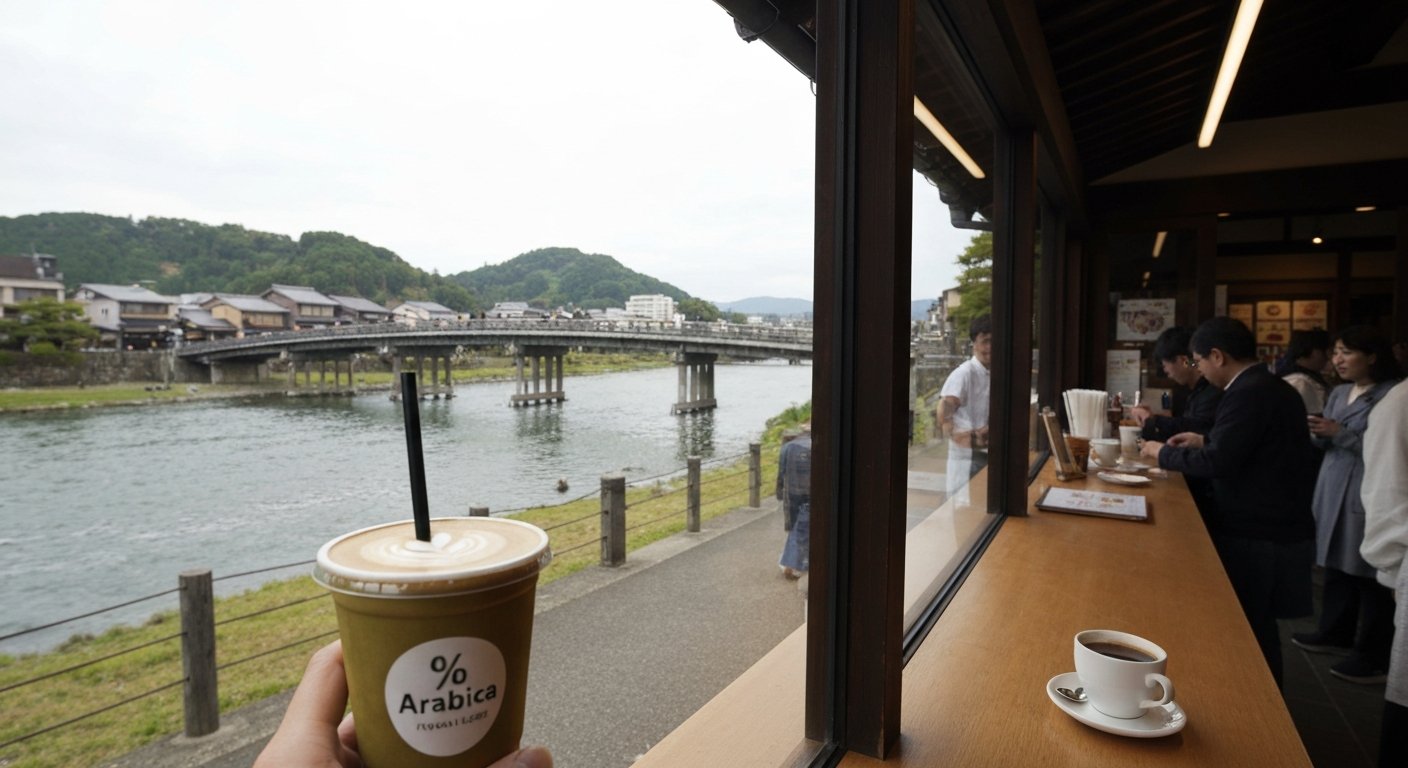
For coffee, there is really only one address that matters if you want the view as much as the drink: % Arabica Arashiyama, the brand’s flagship, pours its signature Kyoto Latte from a glass box on the riverbank by the bridge. The line can be stubborn, but the cup is meant to be carried to the water, where the boats drift by and the whole district briefly resembles the photograph everyone came for.
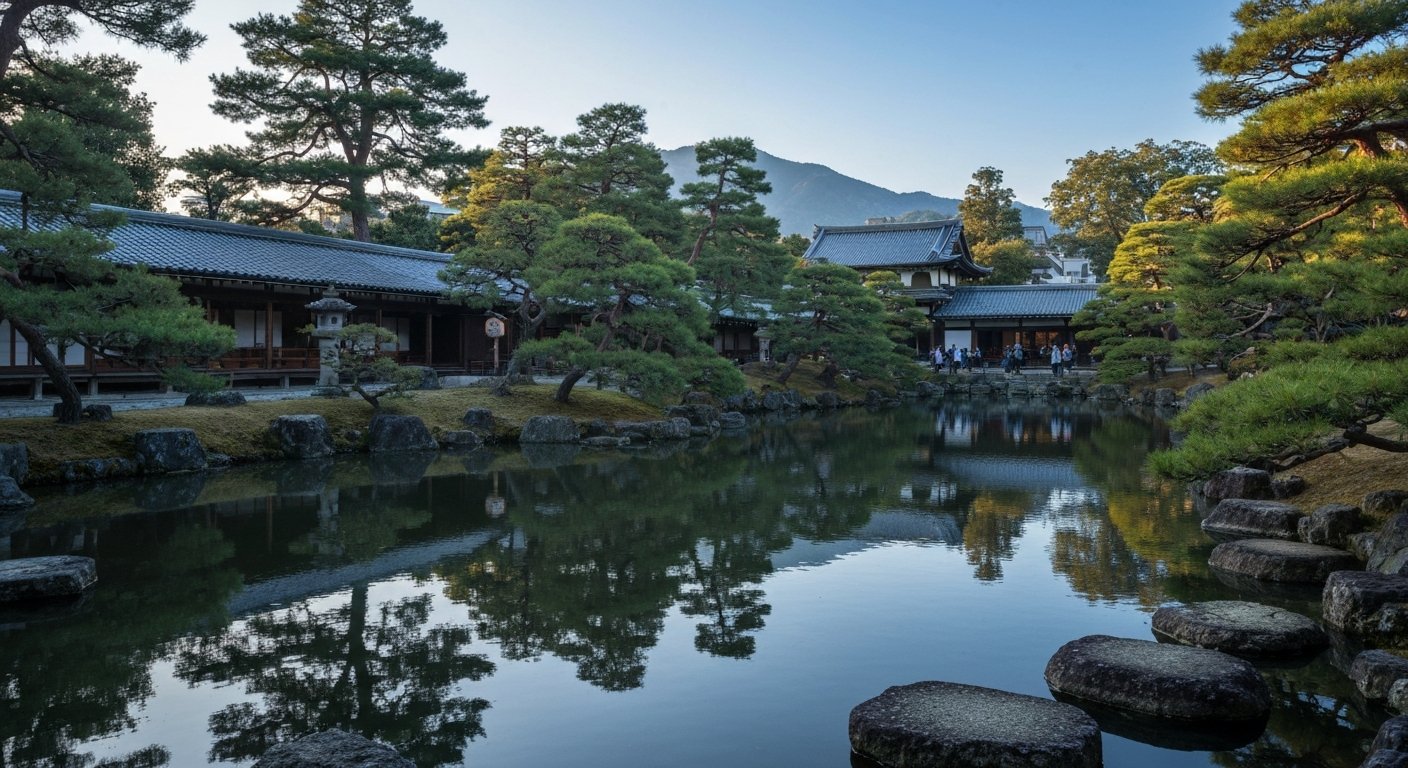
Start with Tenryu-ji, because Arashiyama’s centre of gravity is not the bridge but the temple. The gardens cost ¥500 and open from 8:30 to 17:00. The Sogen-chi pond garden, laid out by the monk Muso Soseki in the 14th century, is one of the finest surviving Zen gardens in Japan, and it works through calm rather than ornament. The borrowed scenery is the point: the mountains are not a backdrop, they are part of the composition. Sit long enough and the garden begins to feel less designed than tuned.
From Tenryu-ji’s north gate, the bamboo grove runs straight ahead and, just off it, Nonomiya Shrine appears almost modestly, a small forest shrine long associated with marriage and safe childbirth. It is easy to rush past here, which would be a pity, because its small scale is part of its dignity. The path then leads on to Okochi-Sanso Villa, the hillside estate of a 1930s film star, where tea houses and viewpoints look over the city. Entry is ¥1,000 and includes matcha and a sweet. The climb is enough to make the tea feel earned.
If you want the quieter Arashiyama, keep walking north into Sagano. Gio-ji is tiny and thatched, one of the district’s most atmospheric corners, with a moss-and-maple grotto that seems designed for people who enjoy their temples with a little dampness. Jojakko-ji climbs a hillside without perimeter walls, which gives it a loose, open feeling unusual in a city where boundaries are often carefully marked. Adashino Nenbutsu-ji goes in the opposite direction, filling its grounds with roughly 8,000 stone Buddhist statues. The effect is solemn, but not in a museum case kind of way; the figures sit in the weather and the moss, looking as though they have accepted their place in the landscape.
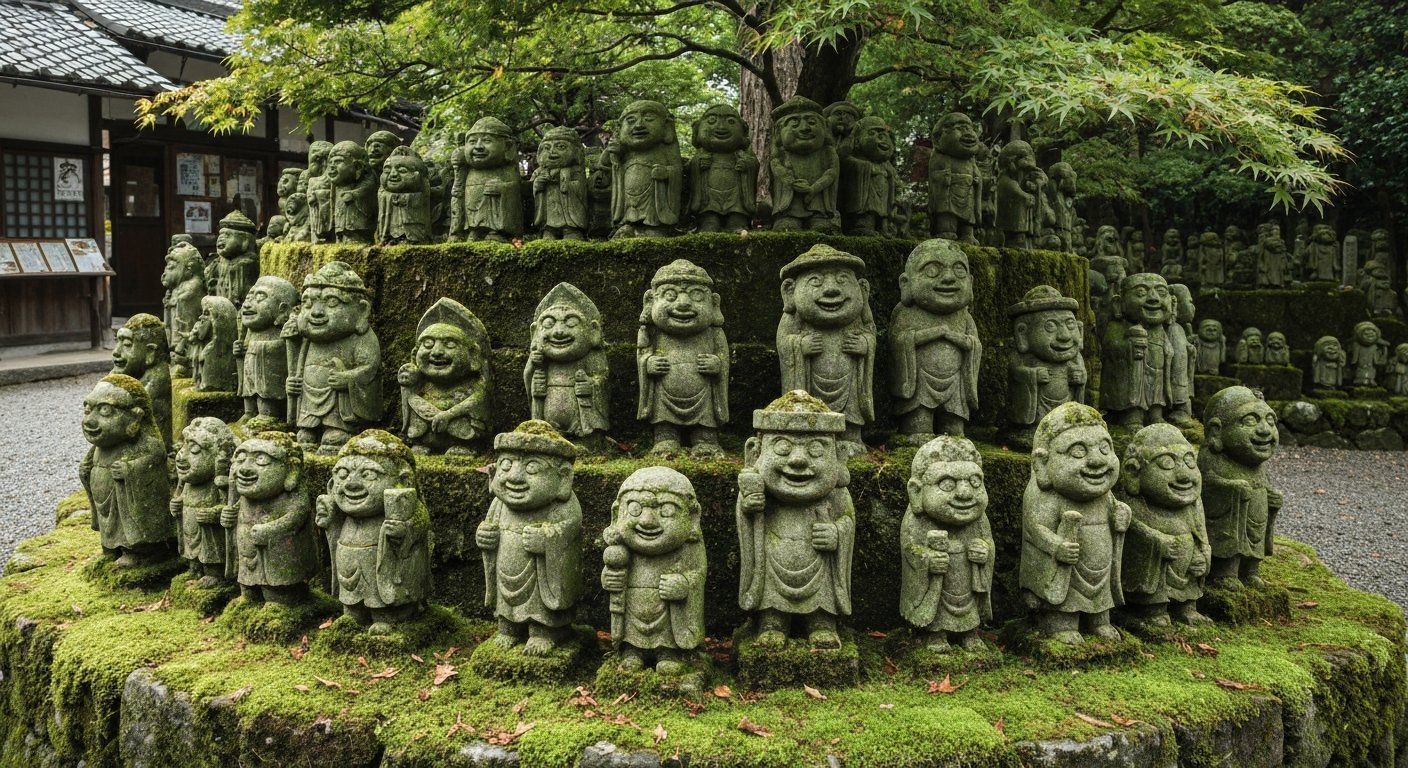
Then there is Otagi Nenbutsu-ji, ¥500 and worth the climb, famous for over 1,200 moss-covered rakan statues carved with wildly individual, often comic faces. Some grin, some squint, some look as if they have just been told an unkind joke. Reaching it along the preserved Meiji-era Saga-Toriimoto street makes the visit feel like a small pilgrimage through time as much as space. The street itself is part of the pleasure: old wooden fronts, a slower pace, and the sense that the district has finally stopped trying to please the day-trippers.
For a different kind of scenery, take the Sagano Scenic Railway, the vintage “Romantic Train” that runs 7km up the Hozu River gorge for around ¥880 one-way. It is closed Wednesdays and over winter, and it is less a commute than a moving viewpoint. The Hozugawa River Cruise brings you back down by wooden boat, a traditional ride through the gorge that makes the river itself feel like part of the itinerary rather than just the thing under the bridge. Families often make the climb to Iwatayama Monkey Park, ¥800, where around a hundred wild macaques roam a hilltop with a sweeping view over Kyoto. The monkeys are the real attraction, of course, though the city spread below is no bad consolation.
The famous Arashiyama Bamboo Grove.
Tenryu-ji Temple with its pristine 14th-century Zen garden.
Togetsukyo Bridge, the iconic wooden landmark spanning the river.
Arashiyama shopping is not subtle, and that is partly the point. The Shotengai runs from just north of Tenryu-ji’s entrance down to Togetsukyo Bridge, a souvenir-and-snack street that leans unapologetically touristy but remains fun if you accept it on its own terms. Here you will find yatsuhashi, matcha sweets, chopsticks, cheap yukata, incense and tenugui cloths, along with a steady line of stalls selling grilled dango skewers and matcha soft-serve. It is a street made for grazing rather than browsing, and for buying gifts you can carry without too much thought.
For something more quietly designed, the Kimono Forest at Randen Arashiyama Station is worth timing. Free and inside the station, it consists of some 600 two-metre acrylic pillars wrapped in Kyo-yuzen dyed kimono fabric, lining the platform and walkways. By day it is pretty; after dark it becomes genuinely lovely, the LEDs lighting the pillars from within until the whole station looks briefly like a lantern installation. The illumination typically runs from sunset to around 9pm. It is one of the few things here that rewards a later hour.
Staying in Arashiyama is a deliberate trade. You give up easy access to Kyoto’s nightlife and central sights, and in return you get the district’s best hours: the grove before the crowds, the river after they leave, the bridge at dusk when the mountains go purple and the place finally exhales. It suits honeymooners, garden-and-onsen seekers, and anyone who wants Arashiyama on quiet-time.
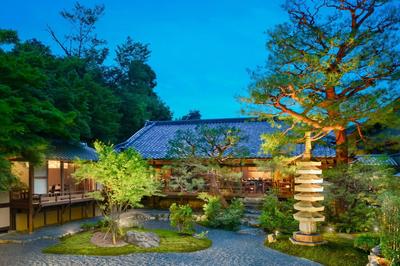
At the top end, Hoshinoya Kyoto is reached only by private boat upstream from Togetsukyo Bridge, a hushed luxury ryokan with river-view rooms and seasonal kaiseki. Suiran, a Luxury Collection Hotel sits on the Katsura riverbank beside Tenryu-ji; many of its rooms have private open-air onsen baths, and it is recognised in the Michelin hotel selection. Both are special-occasion prices, which feels entirely in keeping with the setting. Mid-range and budget options cluster near the JR Saga-Arashiyama and Hankyu stations and along the approach to the bridge, putting you within a short walk of the main sights.
Our best-rated stays in this neighbourhood. Prices are approximate “from” rates — confirmed at the provider when you continue. We may earn a commission if you book through our partners — at no extra cost to you.
In this areaThree rail lines reach Arashiyama, and which one you use depends on where you are coming from and where you want to land. From Kyoto Station, the simplest route is the JR Sagano/San-in Line to JR Saga-Arashiyama Station — about 15 minutes and ¥240 — which leaves you a short walk from Tenryu-ji, the bamboo grove and the bridge. The Randen tram drops you at Arashiyama Station right in the shopping district, with the Kimono Forest beside it, and connects to central Kyoto via Omiya. The Hankyu Arashiyama Line arrives on the south side of the river, roughly a 10-minute walk across Togetsukyo Bridge to the main sights. Bus 28 also runs from Kyoto Station in about 30 to 40 minutes, though traffic can make it feel less like transport and more like waiting with a timetable.
Once you are here, the centre is mercifully walkable. Bridge, grove, Tenryu-ji and the riverfront sit on flat ground within about 15 minutes of one another. The outer Sagano temples — Gio-ji, Adashino Nenbutsu-ji and Otagi Nenbutsu-ji — are a further 20 to 40 minutes uphill, which is worth remembering if you arrive in shoes chosen for aesthetics rather than gradients. The Sagano railway and river cruise work well as a half-day loop. Central Kyoto is 20 to 30 minutes away, and Osaka’s Kansai Airport is roughly 90 minutes by train.
Arashiyama is one of those places that can disappoint the impatient and reward the early. Arrive at the wrong hour and it is a line of people with the same idea. Arrive before breakfast and it becomes what it has always been: a river district at the edge of the city, with temples in the trees, steam rising from tofu, and bamboo making its quiet metallic sound in the wind.
Gallery
Most visitors day-trip from central Kyoto, and that works fine — it is only about 15 to 20 minutes by train. But staying overnight is the best way to have the bamboo grove and riverfront to yourself at dawn and dusk, after the day-trippers leave. If you want that quiet, or a riverside ryokan with a private onsen, book a night; otherwise, day-trip and start early.
Before 8am, full stop. The path is free and open 24 hours, and between roughly 11am and 3pm it becomes a slow-moving crowd. Early morning — or the last light of the day — gives you the near-empty, atmospheric grove everyone pictures. Autumn maples in mid-to-late November and cherry blossom in early April are the most beautiful, and the most crowded.
Almost none. Arashiyama is a daytime district: shops and most restaurants close in the late afternoon or early evening, and the area goes quiet after dusk. The lit-up Kimono Forest at Randen Arashiyama Station is a pretty after-dark stop, but for dinner, bars or nightlife you will head back to central Kyoto.
Arashiyama is best for nature, temples and river scenery — especially if you want a scenic half-day or a special-occasion overnight. It is ideal for first-time visitors who want Kyoto’s bamboo-and-temple imagery in one walkable area, and for garden lovers who are happy to trade nightlife for quiet views.