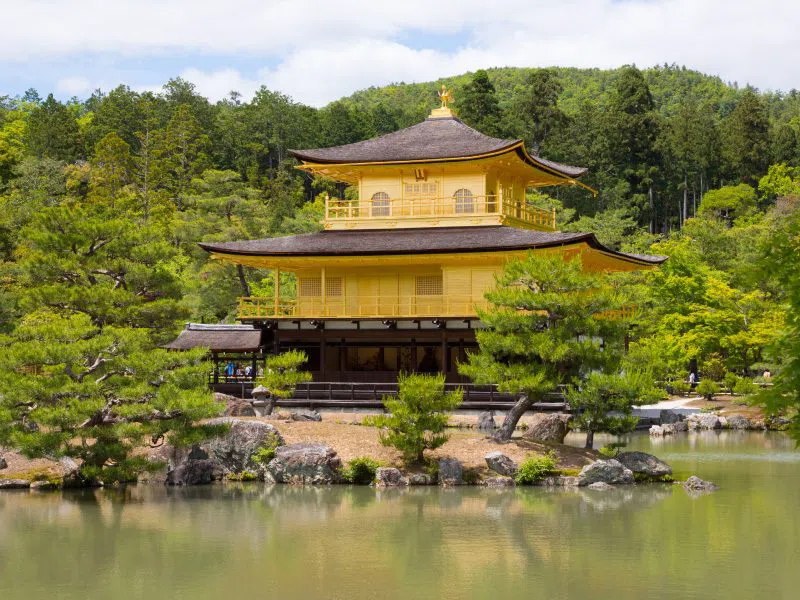
At nine in the morning in October the pond at Kinkaku-ji is still holding the night's cold, and the gold lifts out of the water before the sun has properly cleared the hills behind it. By eleven the same view is a wall of shoulders and raised phones, and the only difference between the two hours is how many people are standing where you want to stand. The hour you choose is the practical problem of visiting the Golden Pavilion, and it is also the only part of the problem you can do anything about.
What you are actually looking at
Kinkaku-ji (Rokuon-ji), in Kita ward on the northwest edge of the city, began as a retirement villa for the shogun Ashikaga Yoshimitsu at the end of the fourteenth century and became a Rinzai Zen temple after his death, as his will instructed. The pavilion is a three-storey oddity, and deliberately so: the ground floor is built in the manner of an aristocratic residence, the middle floor in the style of a warrior's house, the top floor as a Chinese-style Zen hall, with gold leaf covering the upper two storeys and a bronze phoenix on the roof. The building you photograph is not the original. It was destroyed by arson in 1950 and rebuilt in 1955, and the gold was renewed decades later, which is why it reads as so improbably bright beside the weathered timber of most Kyoto temples.
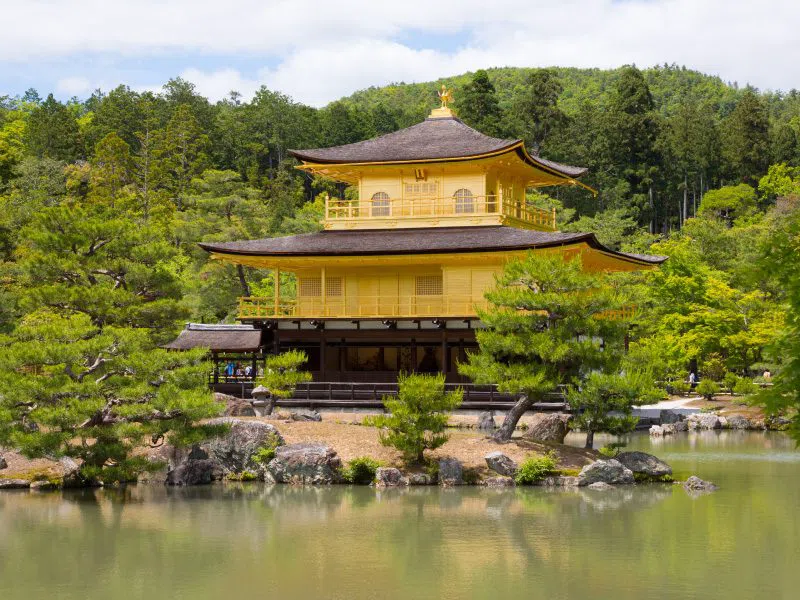
You do not go inside. The path is one-way and the pavilion is viewed from across the Kyoko-chi, the mirror pond, from a strip of gravel that everyone wants to occupy at once. From there the route climbs behind the building past the Ginga-sen spring, the small Sekkatei teahouse and the Fudo-do hall, then returns you to the exit. Walked at a reflective pace, with stops, it takes 40 to 60 minutes. Treated as a photograph it takes fifteen, and plenty of people do exactly that.
Why 08:45 is the only lever you have
The temple is open 9:00 to 17:00 every day of the year, and there is no booking system, no timed entry and no advance ticket of any kind. You cannot buy your way past the crowd, because there is nothing to buy. What there is instead is a daily rhythm: coach parties stack up roughly between 10:00 and 14:00, and the gravel at the pond is where that pressure lands hardest.
So the number that matters here is a time. Be at the gate at 08:45 for the 09:00 opening. You will stand in a short, civilised line of a few dozen people, walk in with them, and get perhaps twenty minutes at the pond with space to move before the first buses arrive. A weekday is better than a weekend, and the first morning of a trip is better than the last, because jet lag is on your side. If you cannot manage the morning, the other end of the day is softer than the middle. Arriving after about 16:00 gives you lower, warmer light on the gold and a thinning crowd, with the understanding that the gate closes at 17:00 and you will be moving.
Tickets at the gate and what a guided day buys you
Admission is ¥500 for adults and ¥300 for primary and junior-high children, and it is cash only at the gate. Bring coins and small notes; this is not the place to discover your card is the only thing in your wallet. If you are travelling as an organised party of 30 or more, the temple asks that you enter together as a single group rather than trickling through the window in ones and twos.
Guided day tours that include the pavilion do exist, and a bookable option is attached to this page. They do not jump a queue, because there is no queue to jump. What they buy is transport, narration and a fixed itinerary. The top-rated of them scores 4.9 out of 5 from 17,289 traveller reviews, and the operator confirms it manually with up to 48 hours' notice, so it is not something you arrange over breakfast on the day. Prices start from about 126 USD per person. Set that against ¥500 at the gate and the choice resolves itself: a tour is worth it if you want a driver, a narrator and the day's logistics taken off you, and it is poor value if what you want is the pavilion with room to breathe, because a coach itinerary will almost certainly deliver you into the 10:00 to 14:00 window.
Walking west along the Kinukake-no-michi
The road running west from the temple is the Kinukake-no-michi, and it strings together three more doors within a comfortable morning's walk. Ryoan-ji (Kita ward, twenty minutes on foot) is the famous dry rock garden, fifteen stones in raked gravel, viewed in silence from a narrow wooden veranda. In October it opens at 08:00, a full hour before Kinkaku-ji.
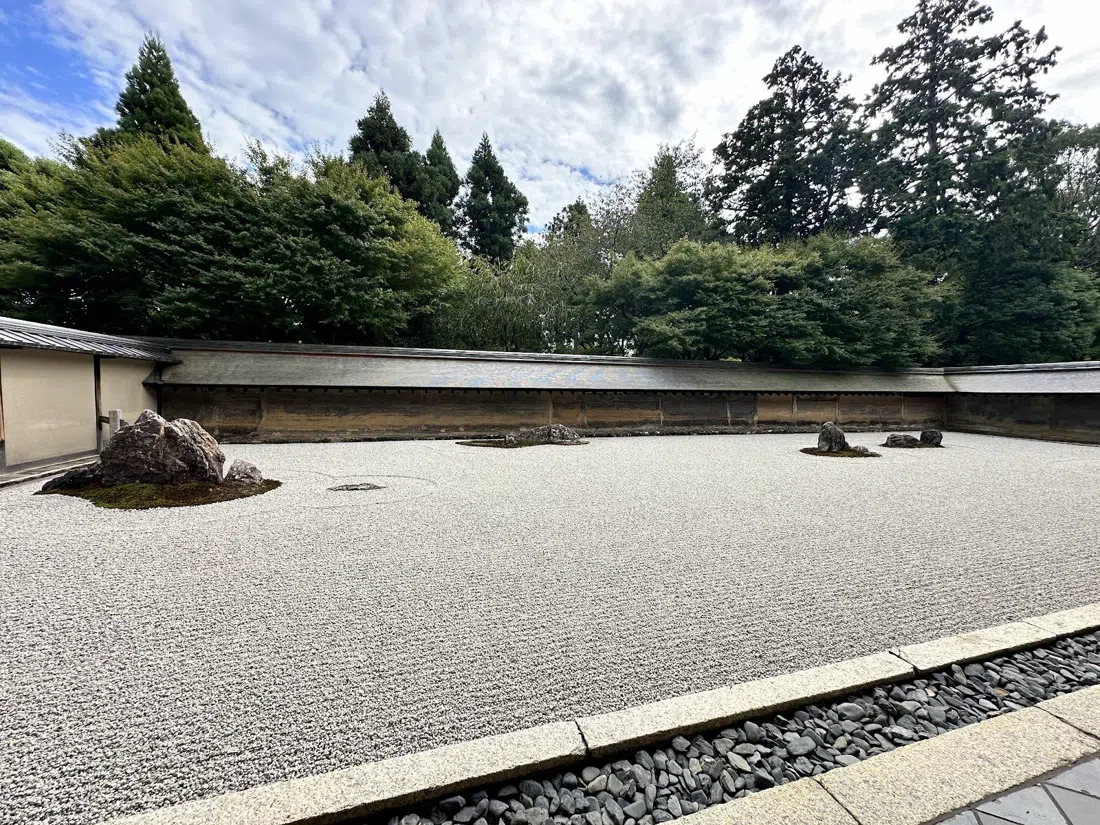
That hour creates the one real scheduling decision of the day, and you cannot have both at their best. If the gold is what you came for, take the 08:45 gate at Kinkaku-ji and walk west afterwards, reaching Ryoan-ji around 09:40 when it is busy but bearable. If silence in front of the rock garden matters more, start at Ryoan-ji at 08:00, have forty minutes of it almost to yourself, and walk east to Kinkaku-ji for a little after opening, still well ahead of the coaches. Either way, large parties should split and brief before they step onto Ryoan-ji's veranda; it is a narrow, quiet space that a group of thirty simply ruins. Entry is ¥600 for adults, ¥500 for high-school students and ¥300 for primary and junior-high.
Between the two sits the Kyoto Prefectural Insho-Domoto Museum of Fine Arts, directly on the Kinukake-no-michi, a small and unhurried building of modern Japanese painting that most visitors walk straight past. It costs ¥580 for adults, ¥450 for students, ¥290 for over-65s and is free below high-school age, with a discount for parties of 20 or more, though the galleries are small, so a group should arrive in waves. It is closed on Mondays, which makes it the only stop on this walk that can be shut while everything around it is open.
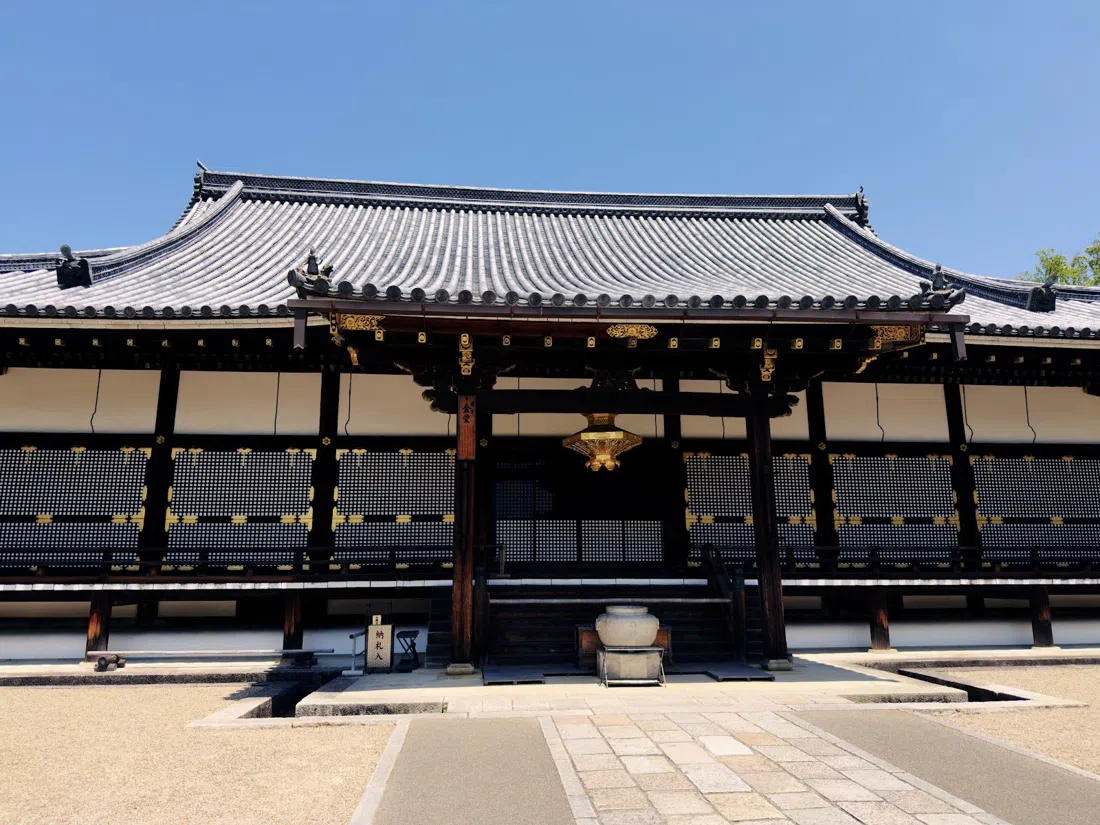
At the far western end is Ninna-ji (Omuro, Ukyo ward), an imperial temple with grounds wide enough to absorb coaches without feeling trampled, and the right third stop of a morning. The Goten palace and its gardens are ¥800, the outer grounds are free, and parties of 15 or more get a discounted rate. October is the specific reason to come: the Reiho-kan treasure museum opens only in April and May and again in October and November, so a visit in this window catches a door that is closed for most of the year, for ¥500.
Where to sit still
The pavilion gives you a view in rather than a view out, and no reason to stop moving. For that, three places are worth knowing. Inside the grounds, Kinkakuji Fudogama Chasho (by the Fudo-do, on the exit path) is a plain tea stall with benches where you buy a ticket and drink matcha with a sweet for around ¥500. There is no tea-ceremony etiquette to get wrong and no reservation to make; it is open year-round with no closing day. It handles a few people at a time, so a coach party belongs on the outdoor benches, not in the queue.
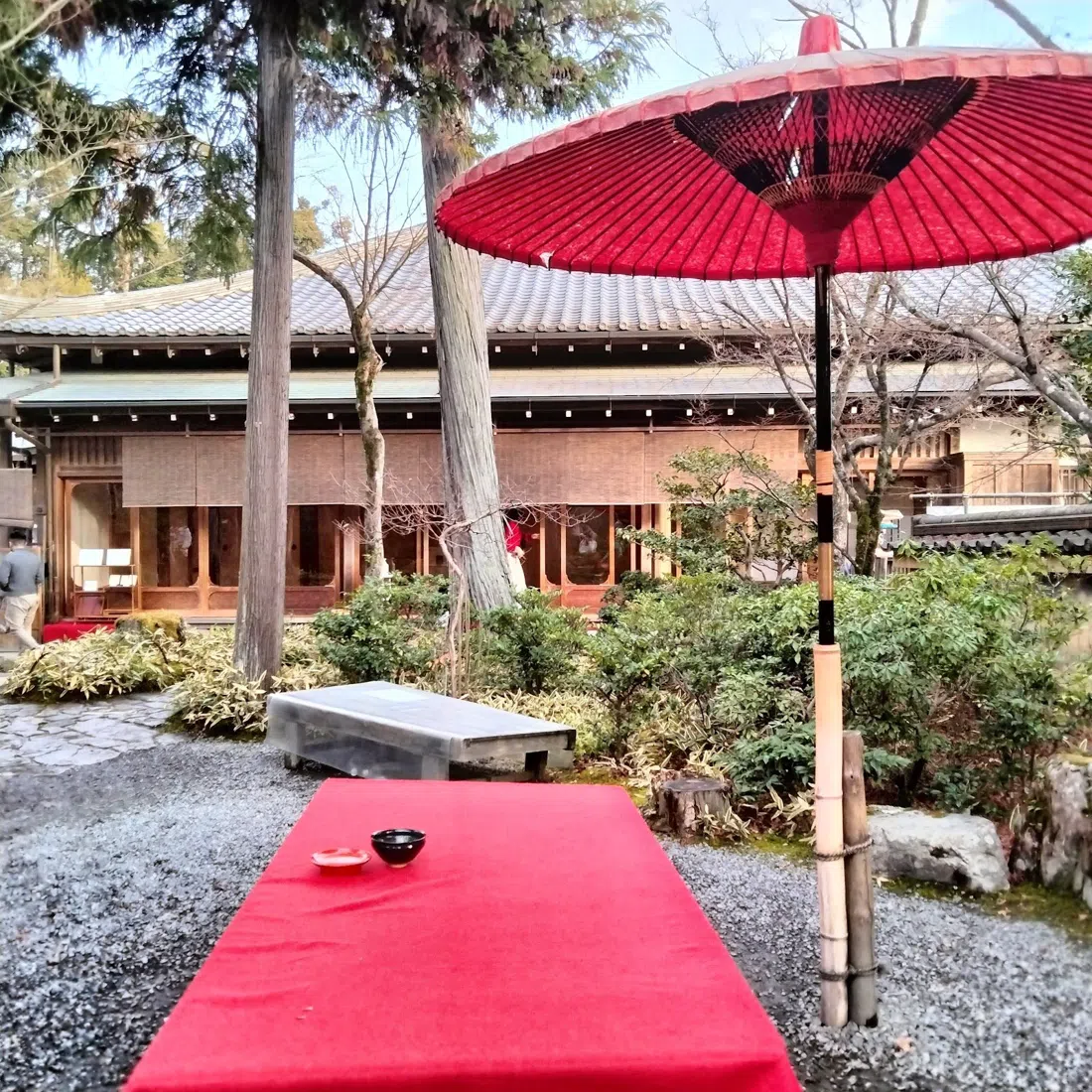
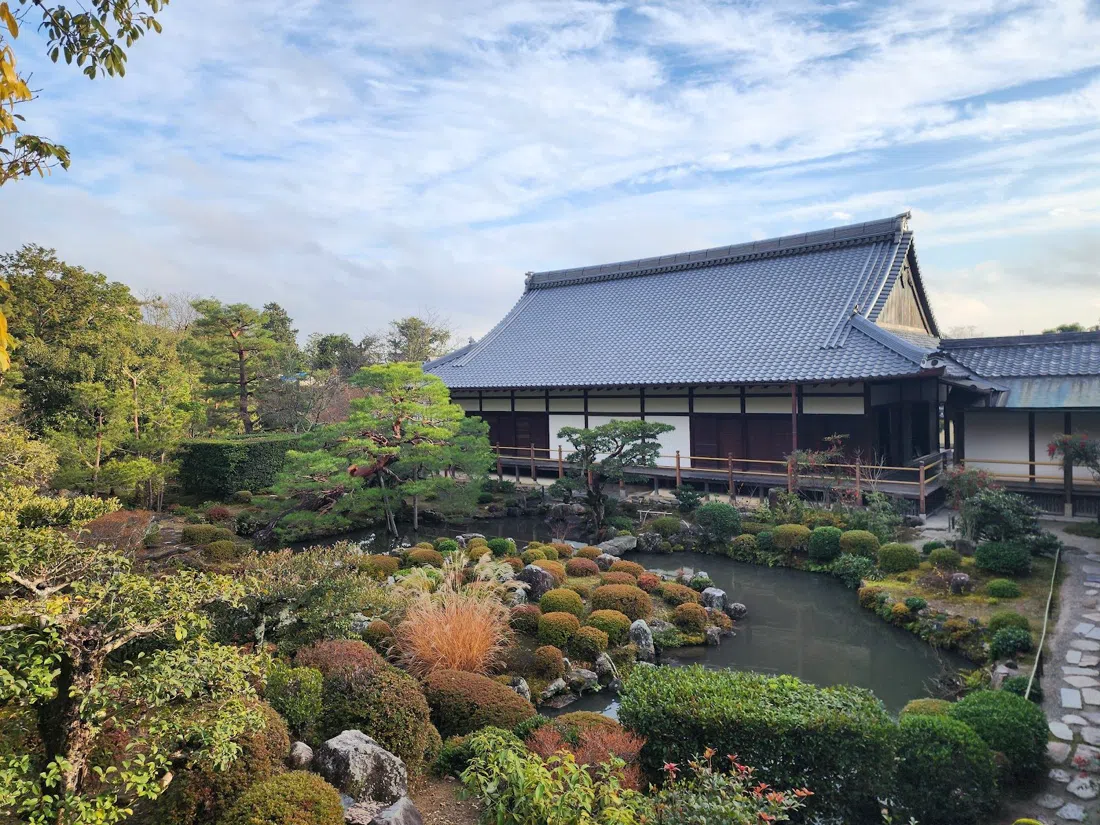
Five minutes' walk from the gate, Toji-in (Kita ward) is the quiet counterweight to the gold. Founded in 1338 by Ashikaga Takauji, it is a small temple with a veranda, a garden and very little else, and it is where you go to sit down and look at something alone. Entry is ¥500, with a matcha set a further ¥500. It is tiny and hushed, suitable for a handful of people rather than a group.
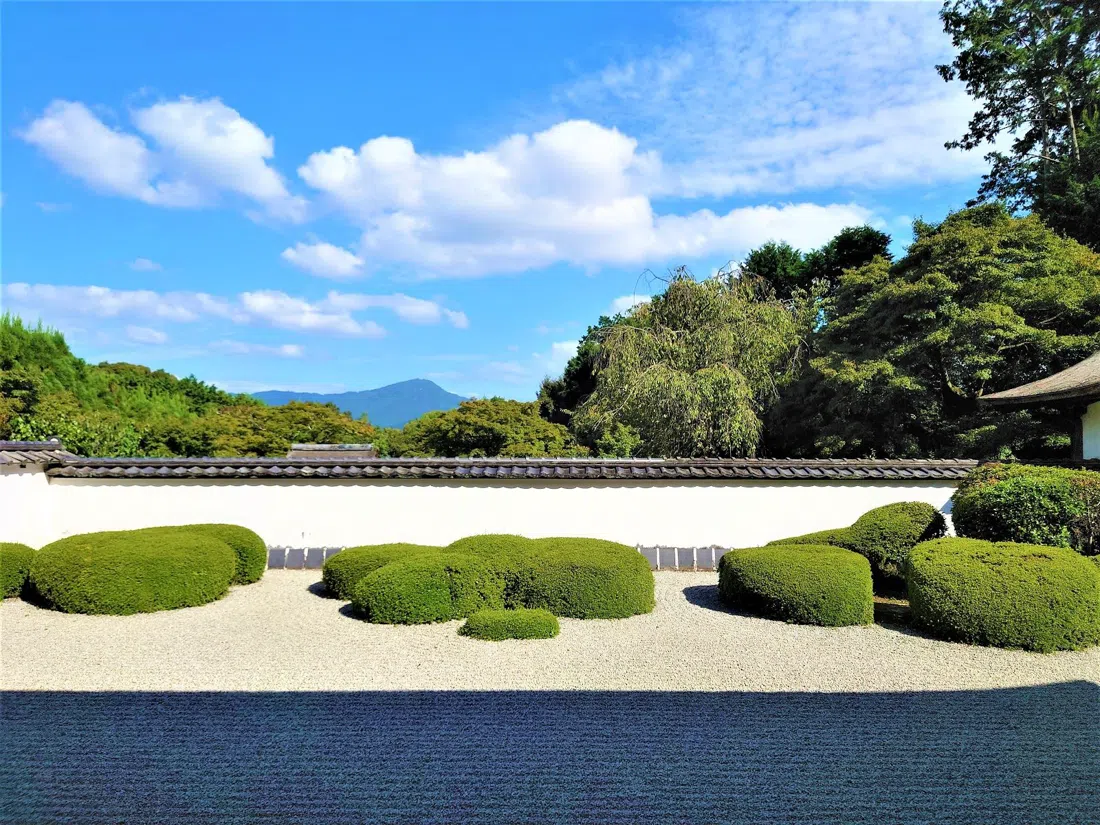
Further north, Shoden-ji (in the hills above Kinkaku-ji) is the textbook example of shakkei, borrowed scenery, where the clipped hedges of the garden frame the mountain beyond as though the mountain were planted there. It is ¥500 for adults, ¥300 for junior-high and ¥200 for primary, it feels close to unstaffed, and it is genuinely empty. If Ryoan-ji at midday has given you a rock garden with a soundtrack of other people's conversations, this is where you go to get the experience you were promised.
What October does and does not give you
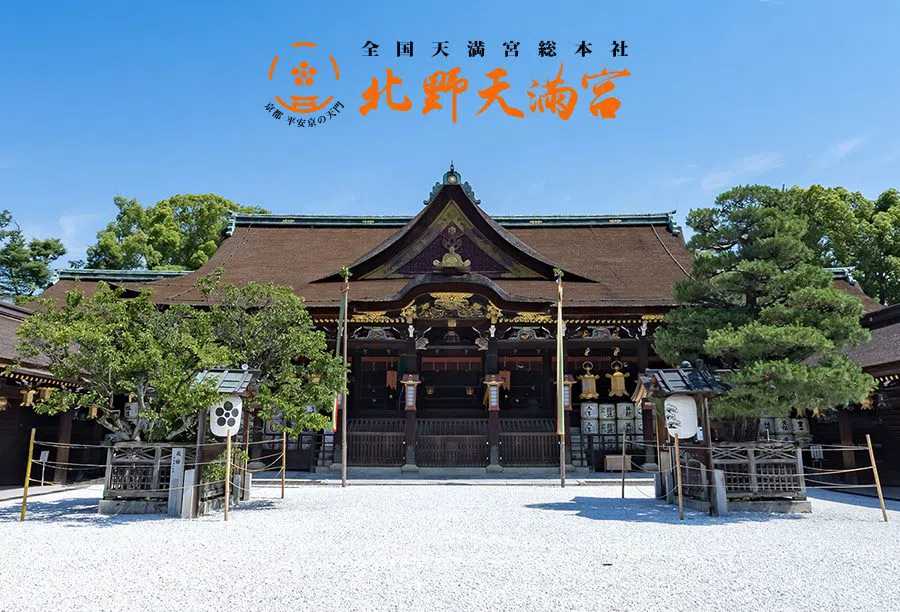
October in north Kyoto is a month of good walking rather than red leaves, and it is better to know that now than to arrive expecting the postcard. The air is dry, the light is clean, the hills are green turning tired, and the serious leaf crowds have not yet landed. Two places mark the hinge. Kitano Tenmangu (Kamigyo ward, one bus stop south of the temple) has free shrine grounds that absorb any number of people, and a paid maple garden, the Momiji-en, which opens for daytime viewing from late October into early December at ¥1,500 for adults and ¥700 for primary children, sweets included. It is a timed-entry ticketed area with a last admission and a no-tripod rule, and the evening illumination does not start until November. A late-October visit catches the first of its daytime days.
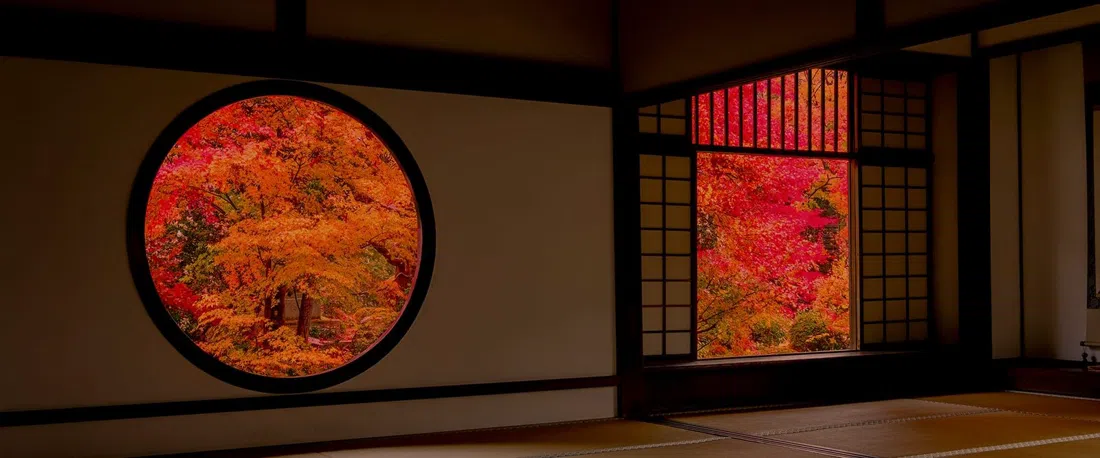
Genko-an (Takagamine, in the hills above Kinkaku-ji) is the other. Its round and square windows, the most photographed pair in north Kyoto, fill with red in mid to late November, not October. Admission is roughly ¥400 normally and around ¥600 during the leaf season. The temple's own notice asks visitors not to arrive by car in that season, so come on foot or by bus. In October you will find a small, calm hall and two beautiful empty frames, which some readers will prefer. For the wider seasonal picture across the city, the Kyoto guide sets out what each month actually looks like.
Lunch, coffee and the afternoon that follows
A 09:00 start leaves the whole afternoon open, and the obvious place to spend it is Daitoku-ji (Murasakino, Kita ward), a walled village of Zen subtemples where the lanes are free to wander and each subtemple charges and admits separately, at roughly ¥400 to ¥600. Four of them, Koto-in, Daisen-in, Ryogen-in and Zuiho-in, are open all year, with additional halls unlocked for the autumn special viewings. Several are strict about photography and silence, and because admission is per subtemple a group has to be broken up rather than marched through.
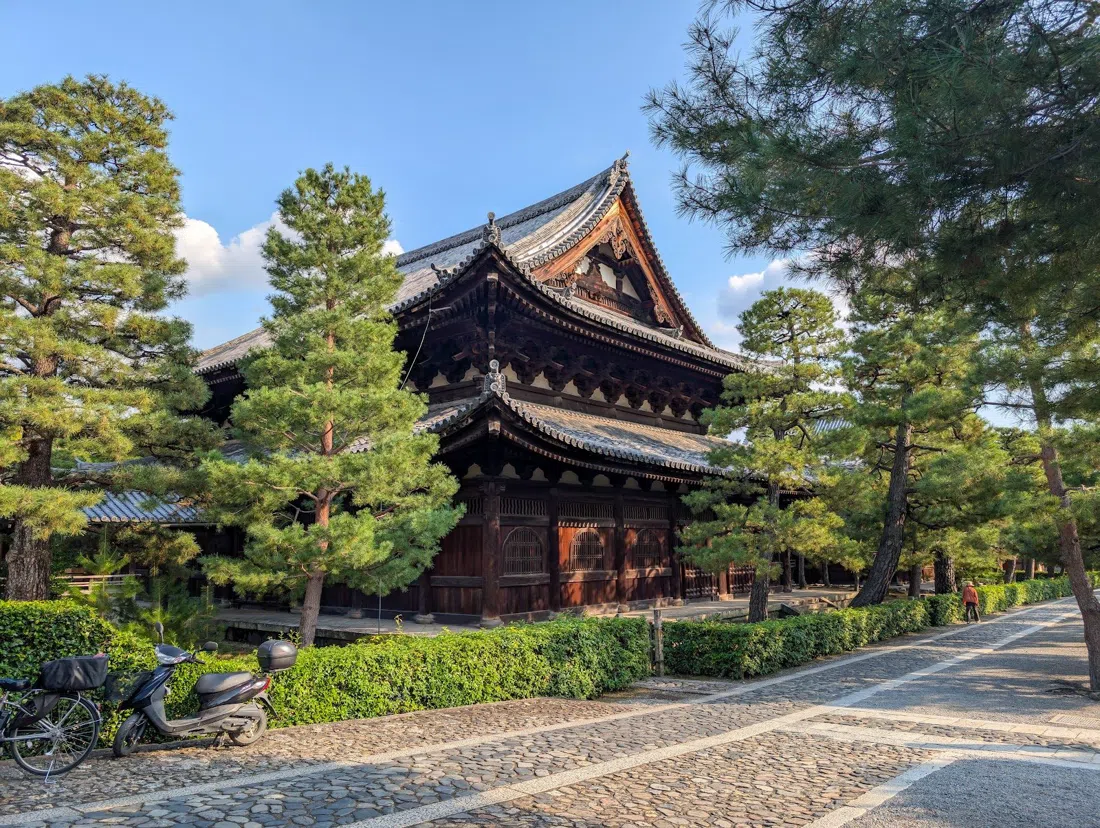
Lunch inside the complex is Izusen (in Daiji-in, Daitoku-ji), a shojin ryori restaurant that is vegetarian by Buddhist doctrine rather than as a menu concession, served in small lacquer bowls on tatami. It takes group bookings on its tatami rooms and is a long-standing stop for guided parties, so reserve ahead; a set lunch runs roughly ¥4,000 to ¥7,000 per person. Service is 11:00 to 16:00 daily, which is the practical argument for the early temple visit: do the pavilion at 10:30 and you will be eating convenience-store onigiri instead.
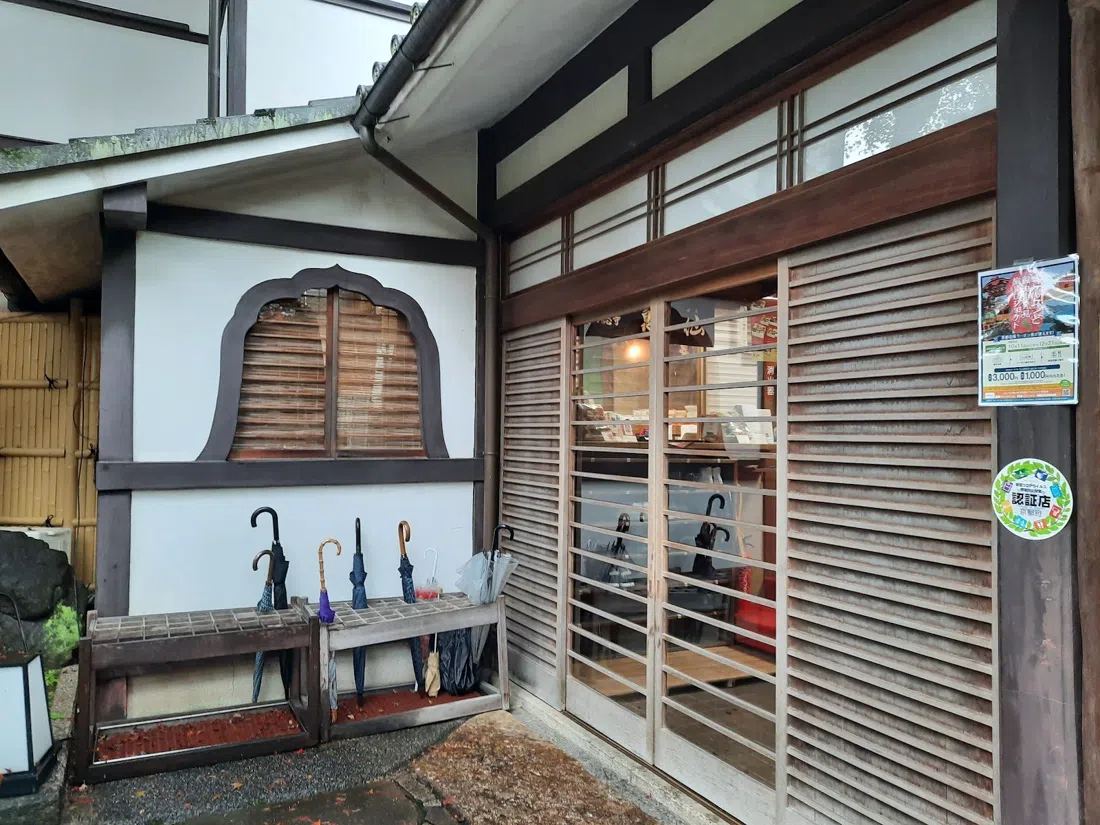
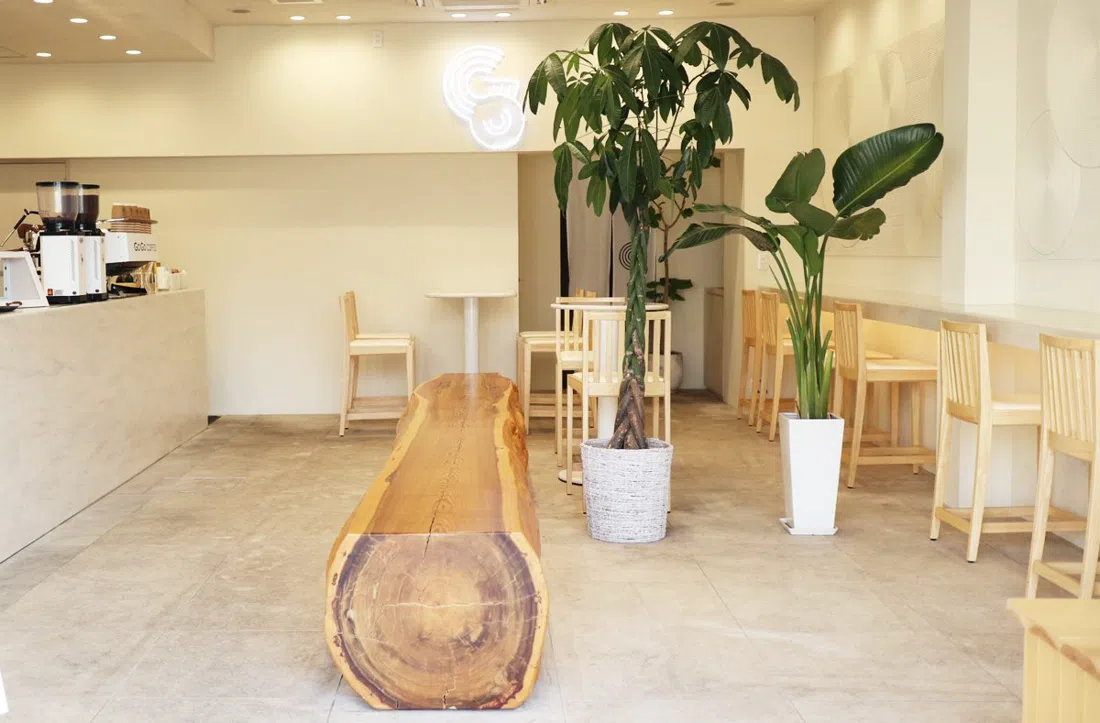
Closer to the gate, the immediate surroundings of Kinkaku-ji are souvenir stalls and little else, with one exception. GOGO COFFEE (three minutes from the Kinkaku-ji gate) is a counter-sized speciality bar roasting in-house, open 09:00 to 18:00, with drinks at ¥500 to ¥900. It holds a couple of people at a time and a tour group should not attempt it. If you have more time, walk east into Sarasa Nishijin (Nishijin), a café-restaurant that has occupied the shell of the old Fujinomori bathhouse since 2000, tiled walls and high ceiling and the whole bath architecture intact around the tables. Lunch is ¥1,200 to ¥2,000 and coffee with cake ¥600 to ¥900. It is walk-in and fine for small groups, and it is closed on Wednesdays, which catches people out regularly.

Ending on hot water and a hill
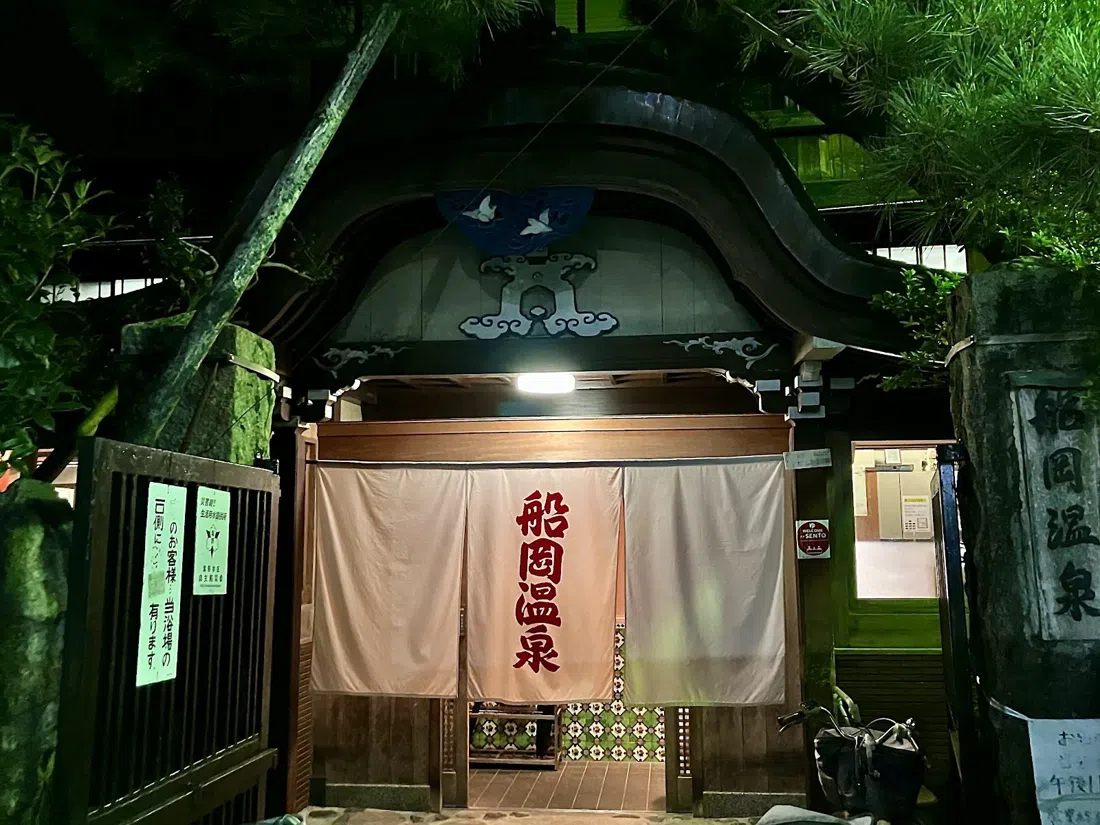
Three minutes from that café is Funaoka Onsen (Nishijin), a working neighbourhood bathhouse over a century old, with its changing rooms and baths listed as national cultural property in 2003. There are carved transom panels above the lockers, an outdoor rotenburo, a sauna, and local regulars who are there to wash rather than to sightsee. Entry is about ¥500 with towel rental around ¥230. It opens at 15:00 on weekdays and 08:00 on Sundays, and closes on Tuesdays, so it only ever works as an end-of-day stop. It is widely reported as tattoo-tolerant throughout, including the outdoor bath and sauna, though the house publishes no written rule either way. Anyone going in with a group should understand sento etiquette first: wash thoroughly at the seated showers before entering any bath, no towels in the water, keep your voice down.
Finally, because the pavilion famously has no outward view, Funaokayama Park and Kenkun Shrine (above Nishijin) is the correction: a 10 to 15 minute climb to the only proper free viewpoint in this quarter of the city, open around the clock and unstaffed. The summit paths are narrow and unlit, so judge the light before you go up late.
Is it worth it
Yes, with a condition attached. Kinkaku-ji at 09:00 is one of the most startling single sights in Japan and costs ¥500. Kinkaku-ji at 11:30 is a fifteen-minute shuffle past a building you cannot enter, in a crowd, and people leave calling it overrated. On that evidence they are right. The temple gives you no way to manage this other than the hour you choose, so the hour is the decision. It suits anyone prepared to set an alarm, and it suits travellers who understand that the pavilion is a 45-minute visit inside a half-day neighbourhood, not a destination on its own. Visitors with limited mobility should know the route is gravel and gently stepped. Those who want a long, slow, contemplative garden should pair it with Toji-in or Shoden-ji and treat the gold as the opening act rather than the whole programme.
Practical notes for an October visit
City buses 101 and 205 run from Kyoto Station to the Kinkakuji-michi stop in roughly 40 minutes, longer in traffic; an IC card works on board, and a taxi from the central hotels is quick and reasonable if you are splitting it two or three ways and chasing the 08:45 gate. Carry cash. Kinkaku-ji, the tea stall, most of the subtemples and the bathhouse all expect it, and small temple windows rarely take cards. Budget for a full day in this quarter at around ¥2,000 to ¥3,000 for temple admissions, ¥500 to ¥1,000 for tea or coffee, and either a ¥1,500 café lunch or ¥4,000 and up for shojin ryori. October mornings are cool enough for a layer and the afternoons are warm, so dress for both; shoes come off at Ryoan-ji, Ninna-ji's palace and most subtemple halls, so wear something you can slip. Check the closing days before you set out, because two of them sit on the same short stretch of street: the museum on Mondays, the bathhouse café on Wednesdays, the bathhouse itself on Tuesdays. Staying on the north or west side of the city makes the early start realistic rather than theoretical; the Kyoto hotel search will show what is within a short bus ride of the gate.