You take your shoes off at the entrance to Ninomaru-goten and within three steps the building begins talking about you. The nightingale floors answer every footfall with a thin metallic chirp, hundreds of nails and clamps shifting in their sockets, and at a quarter to nine on a September morning you can hear the sound run ahead of you down a corridor of gold screens with nobody else in it. Come back at half past ten, when the coaches have unloaded on Horikawa-dori, and the same corridor is a slow river of socks and shoulders with the birds drowned out entirely. The whole argument for how to do this castle sits in that gap of one hundred and five minutes.
What you are walking into
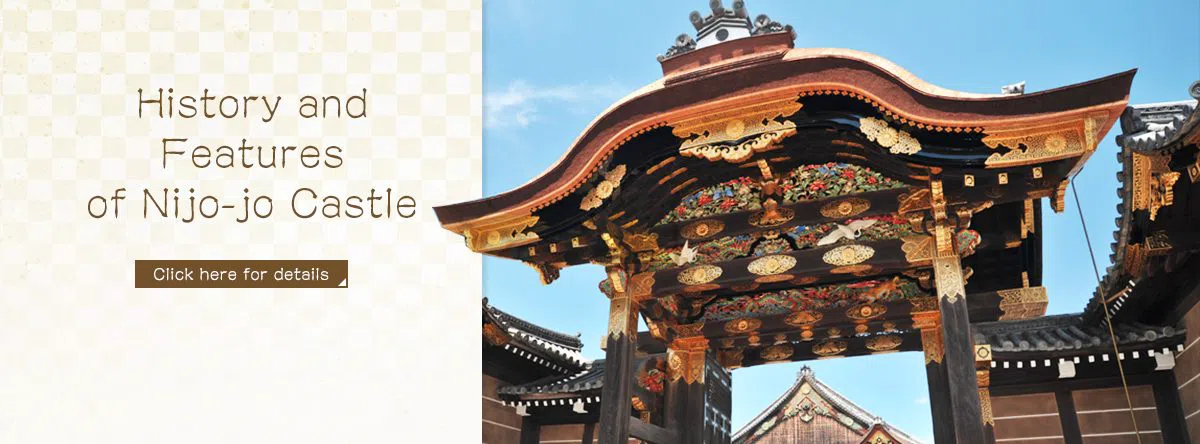
Nijo-jo Castle (Nijojo-mae, on Horikawa-dori in central Kyoto) was completed in 1603 as Tokugawa Ieyasu's residence in the emperor's city, and it was never seriously built to be defended. It was built to be entered. The wide moats, the low walls and the enormous Karamon gate with its gilded carvings are a political argument made in timber and gold leaf, addressed to a court that technically outranked the man who paid for it. Two and a half centuries later, in 1867, it was in these same rooms that the last Tokugawa shogun announced the return of governing power to the emperor, which makes the building both the opening and closing statement of the age it belongs to. It has carried a UNESCO World Heritage listing since 1994.
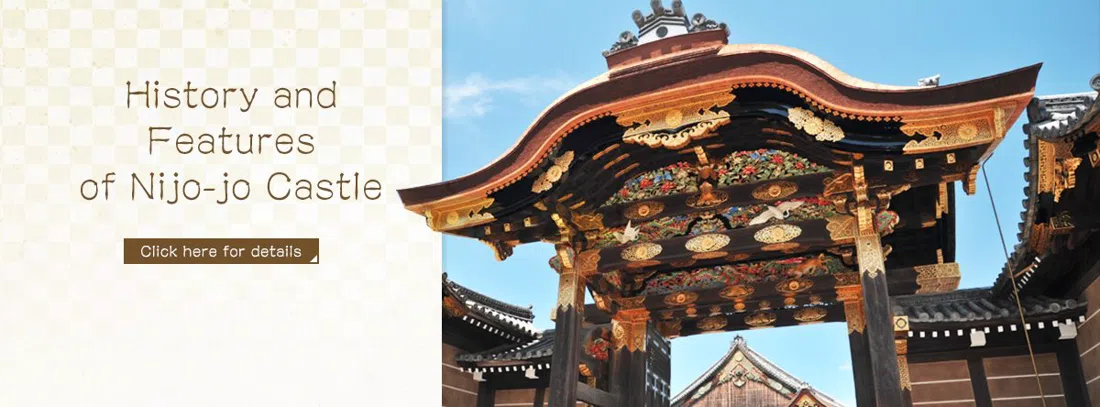
The standard route takes you through Ninomaru-goten, five linked single-storey buildings arranged in a diagonal so that light falls into every wing. You move through graduated waiting rooms and audience chambers, each one telling a visitor exactly where he stood in the hierarchy: tigers and leopards on the screens where retainers were kept waiting, softer pines and herons closer to the shogun. The floors sing the entire way. Afterwards you come out into the Ninomaru garden, cross the inner moat, and can climb the stone base of a keep that burned down long ago for a view over the treetops and the roofline of the city. Grounds-only admission is ¥800; you want the ¥1,300 ticket that includes Ninomaru-goten, because without the palace interior you have paid to walk around a very handsome park.
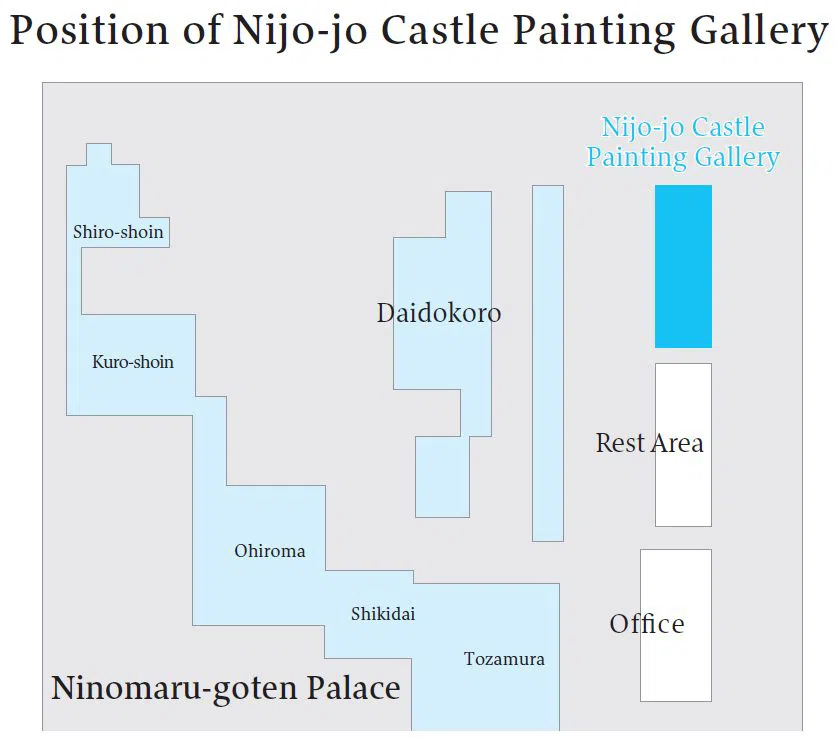
The signage is honest about one thing that visitors still miss: almost everything you photograph (sorry, everything you look at, since cameras are not allowed inside) is a reproduction. The original screens were lifted out for conservation and hang in the Nijo-jo Castle Painting Gallery (inside the castle walls, a few minutes from the palace exit), which costs ¥100 on top of admission. It is the best-value ten minutes on the site by a distance. Exhibitions rotate roughly quarterly, so if you have come specifically for a particular tiger, check what is actually hung before you promise it to anyone.
The reopened Honmaru-goten and why it changes the day
The single strongest reason to build a slower morning around Nijo in 2026 is Honmaru-goten Palace (inside the inner moat), which returned to public view in 2024 after a long restoration. It is a different register from Ninomaru: a nineteenth-century aristocratic residence rather than a shogunal stage set, with painted rooms that feel lived in rather than performed in. Entry is ¥1,000 on top of castle admission, ¥300 for junior and senior high school students and ¥200 for elementary age, and it runs on timed slots because of cultural-property limits on how many bodies can be inside at once.
Book the web ticket when slots release thirty days out. Two consequences of the timed entry are worth planning around. First, Honmaru closes on the third Monday of each month while the rest of the castle stays open, so check your date. Second, there is no group rate at all here, and coach parties have to be split across slots, which is why large tours often skip it entirely and why independent visitors and small private groups get the better experience.
How long it takes and when to arrive
Gates open at 8:45, last entry is 16:00 and the site closes at 17:00. Grounds plus Ninomaru-goten is ninety minutes if you walk steadily and do not sit down. Add the painting gallery, a Honmaru slot and a bowl of tea and you are at three hours, comfortably three and a half if you are the sort of person who reads every panel.
Arrive at 8:45. This is the whole trick and it is not a secret, it is simply inconvenient, which is why it keeps working. The first forty-five minutes of the day are genuinely quiet; the pressure builds with the ten o'clock arrivals and stays high through early afternoon. September gives you a second reason to be early: the routes are wide flat gravel with long unshaded stretches, and the first half of the month in Kyoto is still hot and humid enough that a late-morning circuit of the moat walk turns into work rather than pleasure. Weekdays are noticeably easier than weekends, and the last hour before 16:00 has its own quiet, though you lose the low morning light on the Karamon carvings.
Tickets at the door and when to book ahead
Daytime admission is a walk-up purchase; there is no scenario in September where you cannot buy a castle ticket at the gate. The thing that genuinely needs booking in advance is the Honmaru-goten slot, because that inventory is capped by the building rather than by demand management.
The Nijo-jo Castle English Guided Tour (meeting inside the castle grounds) costs ¥2,500 per adult with castle admission not included. It is the one officially sanctioned English-language tour on site, and it opens a section of the castle that ordinary ticket-holders do not see. If the Tokugawa politics are the reason you came, it earns its money. If you mainly want the gold and the squeaky floors, skip it and save the time for the painting gallery. It runs year-round apart from the castle's own December closure days.
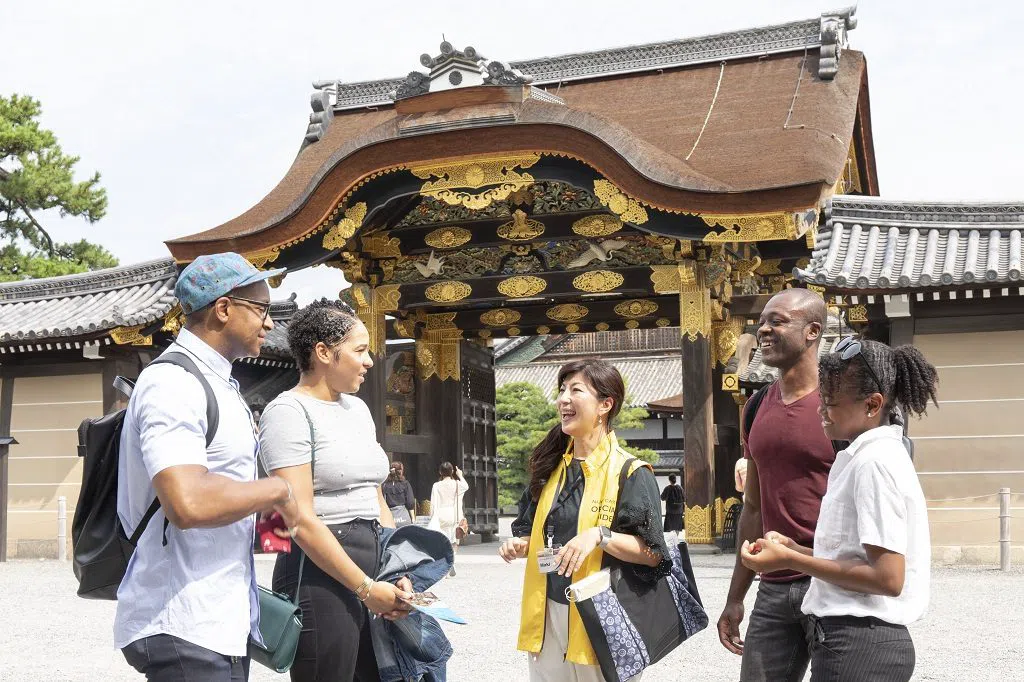
Nijo also works as the anchor of a full-day guided circuit of the city, and bookable options exist from around 102 USD per person, running seven days a week. If you go that way, note that the busiest of these is confirmed manually by the operator with up to 48 hours' notice, so it is not something you arrange over breakfast on the day. That is the honest trade: a coach day removes all the logistics and hands you the castle at exactly the hour it is fullest.
Shoes, cameras and what the site asks of you
Shoes come off at Ninomaru-goten and go into a bag you carry with you, so wear socks you are happy to be seen in and footwear you can slip off one-handed while a queue forms behind you. Photography is not permitted inside the palace at all, not without flash and not discreetly. The floors themselves are a conservation object, so the stewards keep people moving and there is no lingering in a doorway for a clear sightline.
Access is better than most Kyoto heritage sites: flat, wide, gravel-surfaced routes that absorb wheels and walking sticks, though gravel is still gravel. Groups of thirty or more get an official rate of ¥700 for grounds or ¥1,100 including Ninomaru, and charter tours can be arranged through the castle office directly. Junior and senior high school students pay ¥400, elementary ¥300, under-sixes free.
Where to stop for tea inside and just outside the walls
Waraku-an (the Sabo Maeda tea house in the Seiryu-en garden, inside the castle walls) is the only proper café on the site, housed in a three-hundred-year-old merchant residence that was taken apart and moved here. Matcha or sencha sets run roughly ¥700 to ¥1,300, it opens 9:30 to 16:30 with last orders at 16:00, and it is the natural mid-point of a long day. The tatami and bench seating is limited: fine for a couple or a pair, hopeless for a party of twenty, and groups should stagger their arrivals rather than turn up together.
If you want a chair, air conditioning and a proper sit-down within sixty seconds of the exit, HOTEL THE MITSUI KYOTO — The Garden Bar (directly opposite the east gate) is the only real answer. It stands on a site the Mitsui family held for two hundred and fifty years and the prices are five-star Kyoto prices, so treat it as a deliberate splurge rather than a coffee stop. Afternoon tea takes small groups by reservation, and the Kyotamba chestnut menu runs from 16 September to 30 November 2026, which puts it inside a late-September visit. The thermal spring spa is for hotel guests only.
Lunch, sake and the streets the tours drive past
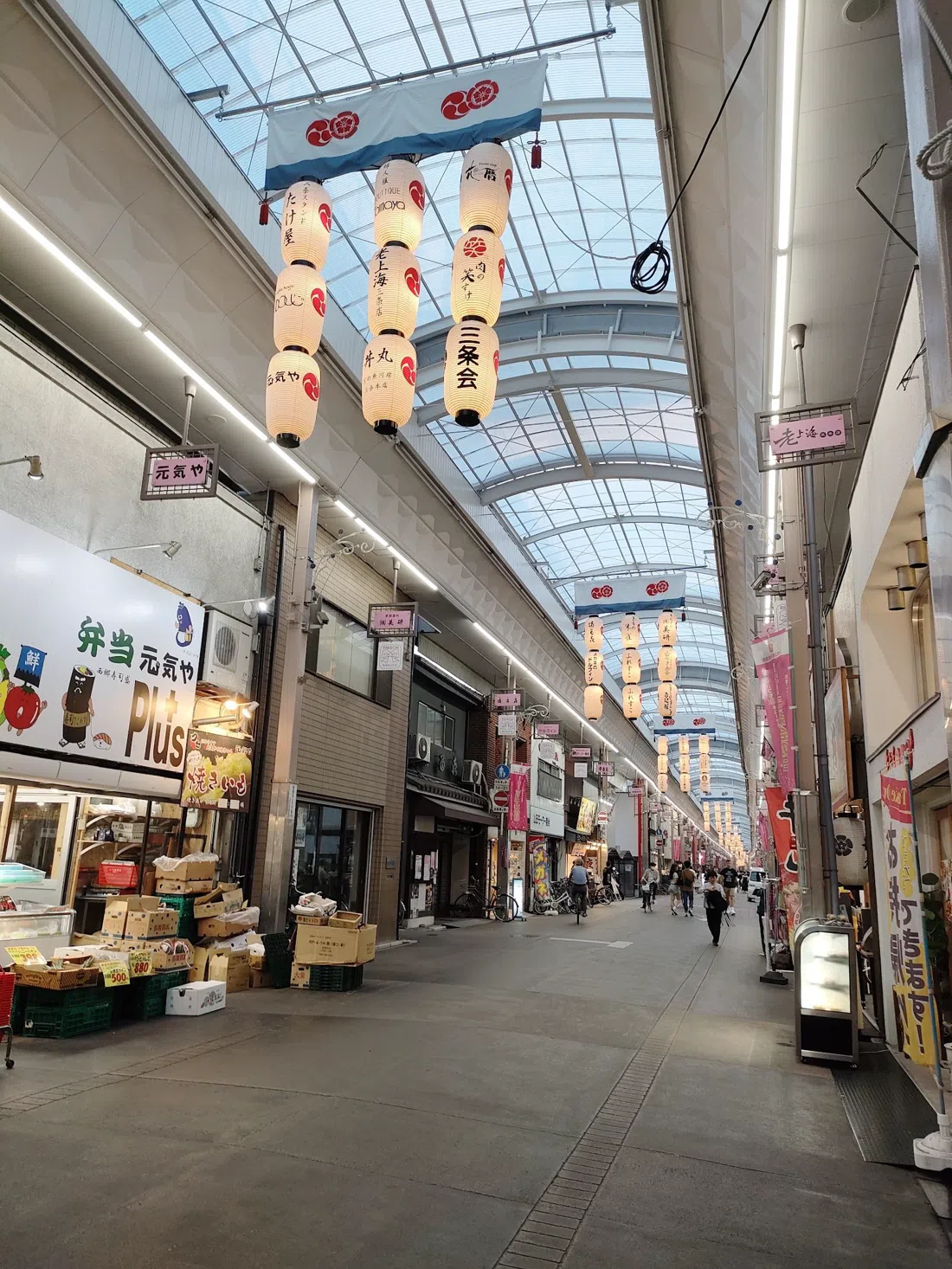
The honest answer to where to eat near the castle without queueing is Sanjo-kai Shotengai (ten minutes west, running through the Mibu and Nishinokyo backstreets), one of the longest fully covered arcades in Japan with something like 180 shops of ordinary Kyoto life: fishmongers, pickle counters, cheap lunch sets from roughly ¥300 to ¥1,200. It is liveliest on Friday and Saturday. It is a public street, so small groups are fine, but a thirty-strong party will plug the narrower stretches at lunchtime and know it.
East of the castle, Café Bibliotic Hello! (on Nijo-dori, towards Teramachi) is the classic machiya café, open 11:30 to 23:00 and closed Mondays, with a bakery next door and coffee and a plate at roughly ¥1,000 to ¥2,000. No reservations, so four or five people can usually make it work and a tour group cannot, particularly at weekend lunchtime. Its long hours make it one of the few places nearby still serving well after the castle turns you out.
For a drink with some history attached, the Kinshi Masamune Horino Memorial Museum (on Nijo-dori) is a brewing house dating from 1781 that survived the great fire of 1864. It opens 11:00 to 17:00 with last admission at 16:30; the guided visit is ¥300 for adults and ¥200 for students, and the shop and beer hall are free to walk into. The rooms are small, so it works in handfuls rather than crowds.
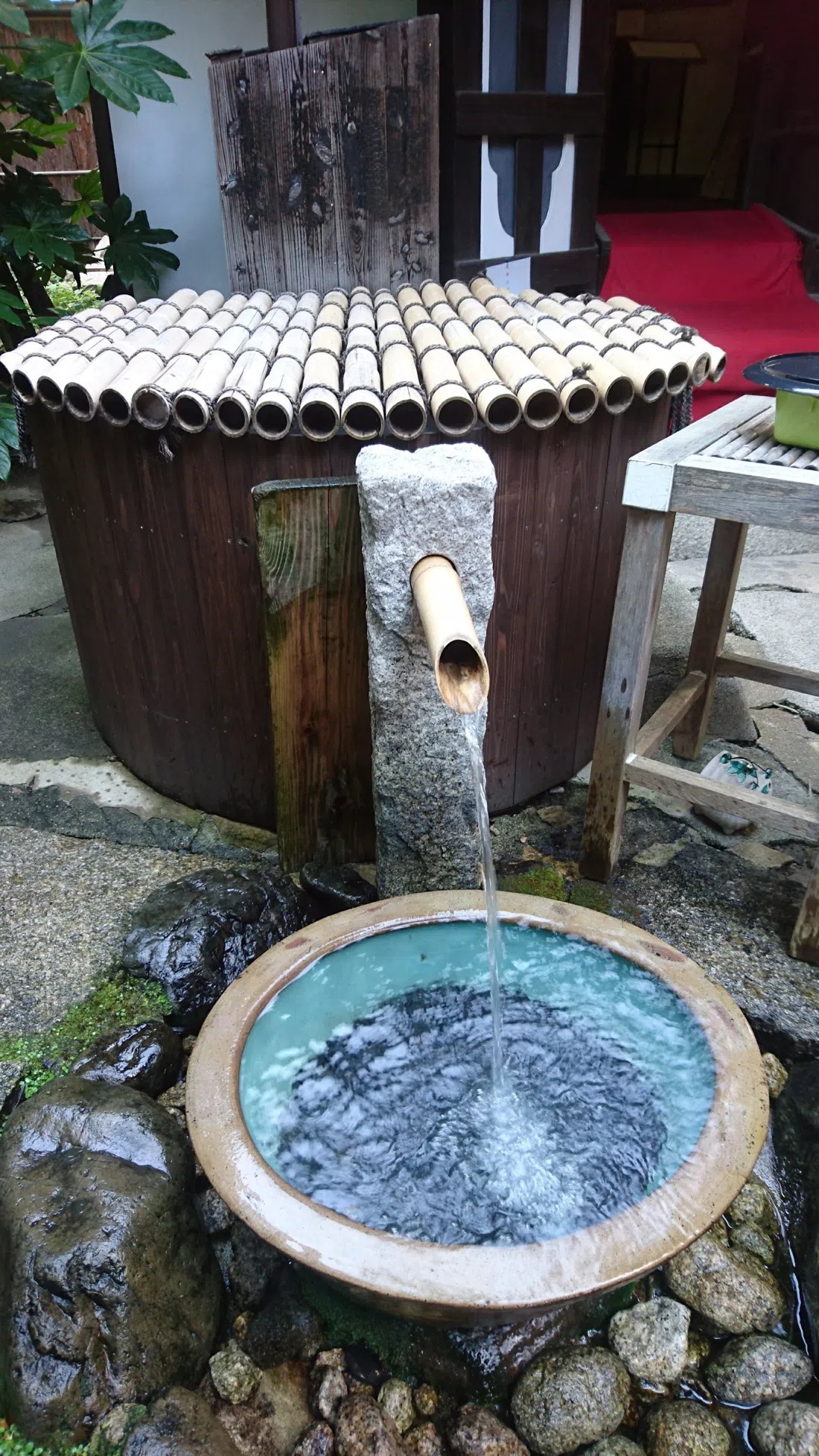
The short walks most itineraries skip
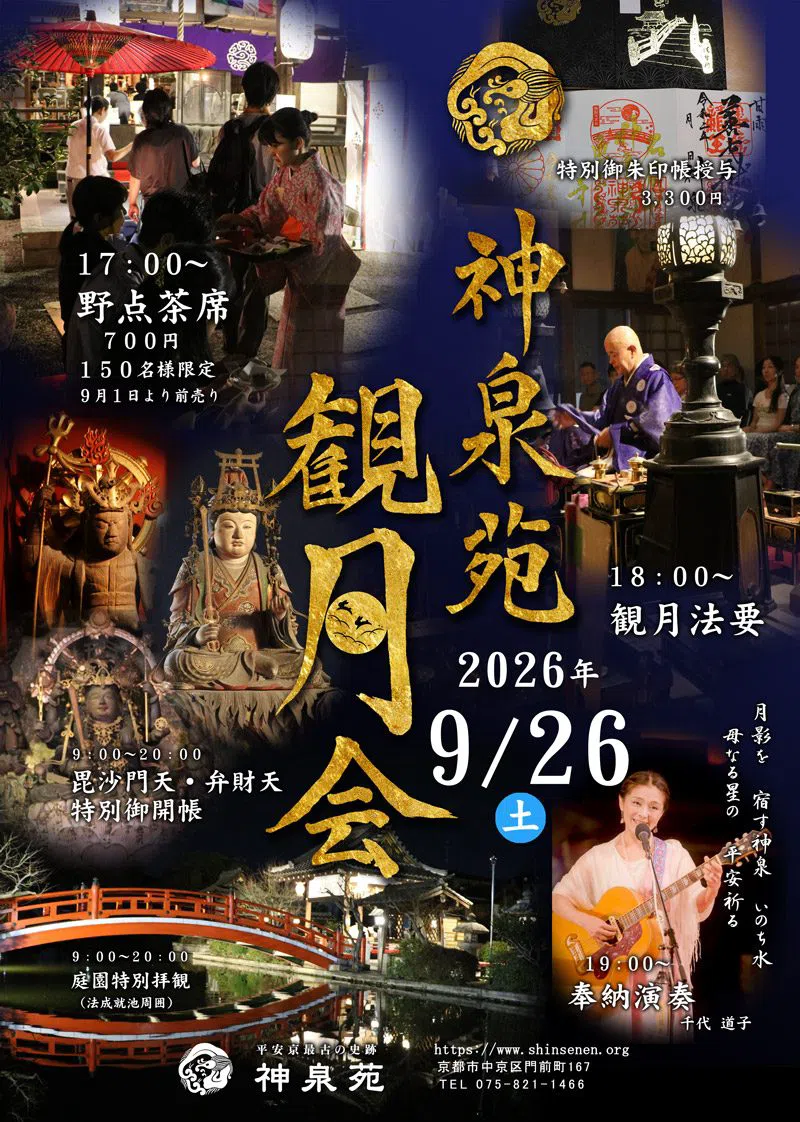
Two minutes south of the castle, Shinsen-en (Nijo, just off Horikawa) is free, open 9:00 to 17:00, and is the surviving fragment of the Heian emperor's pleasure garden, by centuries the oldest thing in the area, and almost nobody on a coach tour is taken there. It is tiny; a guided group can pause, not linger.
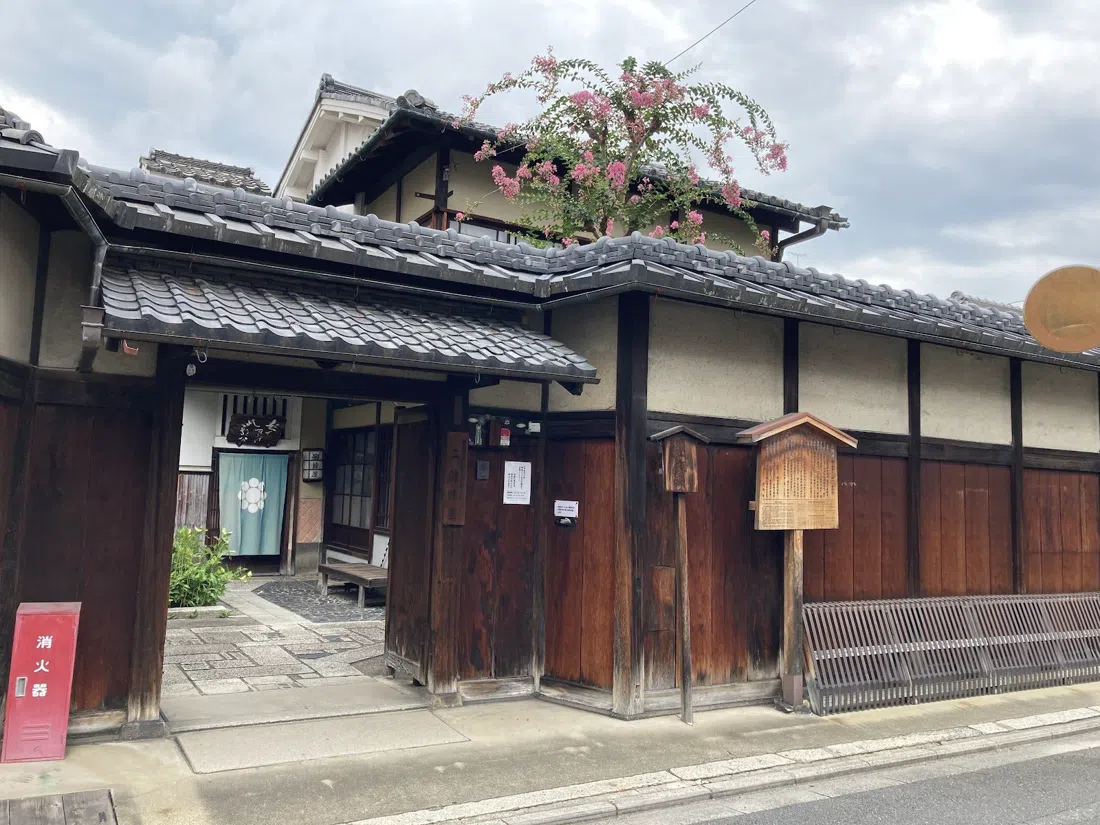
Nijo Jinya (ten minutes southwest) is a National Important Cultural Property riddled with samurai-era trapdoors and concealed stairs, ¥1,000 per person, with real conditions attached: tours are reservation-only, about an hour, at 10:00 and 11:00, in Japanese only, closed Wednesdays. Without an interpreter or a volunteer guide arranged in advance, most international visitors travelling alone should let it go.
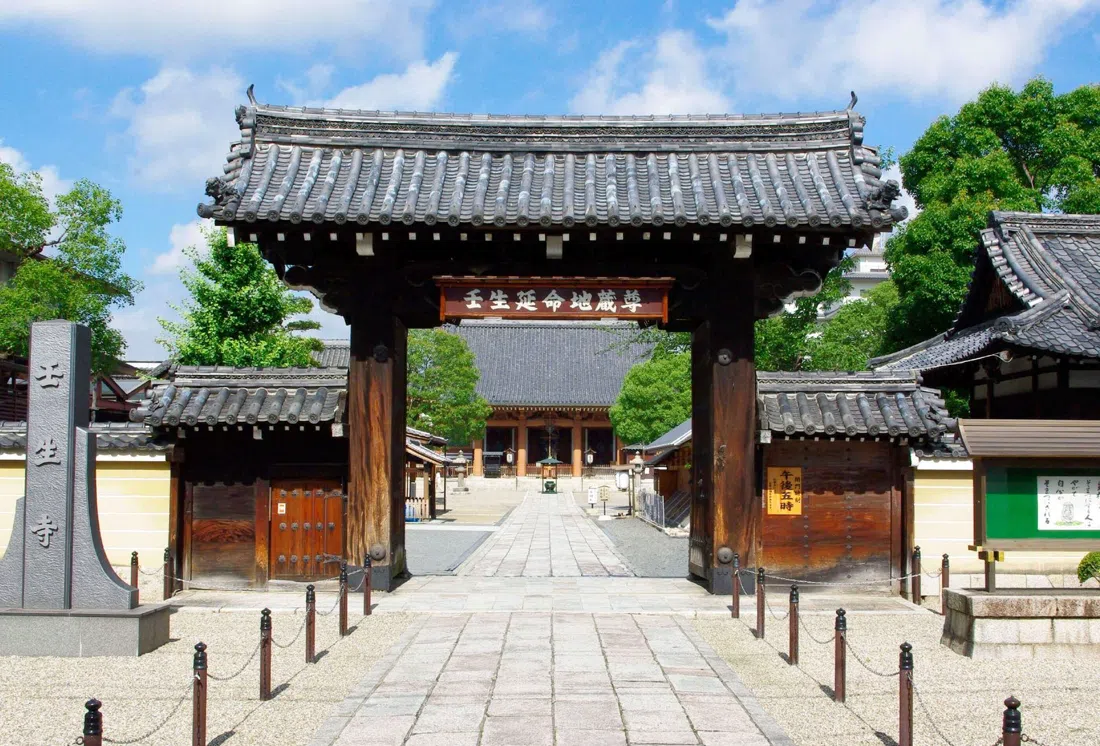
If the Tokugawa story took hold, Mibu-dera (twenty minutes south) is the right second stop, founded in 991 and the barracks-era home of the Shinsengumi, whose commanders are buried in the Mibuzuka. Grounds are free and open 8:30 to 16:30; the graves and archive room cost ¥300 for adults and ¥100 for students, and they are small enough that groups should go through in batches.
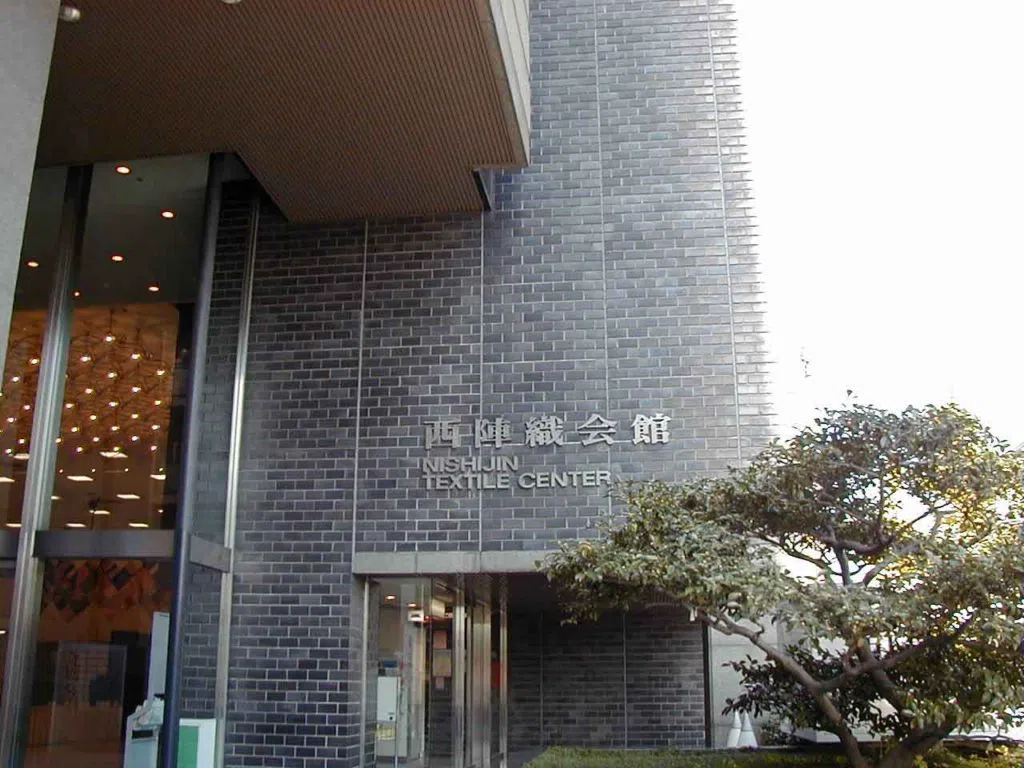
Fifteen minutes north, the Nishijin Textile Center (Nishijin) is free, open 10:00 to 18:00, and puts on free ten-minute kimono shows at 10:30, 11:30, 13:00, 14:00, 15:00 and 16:00. It is frankly part shop, but the looms on the floor are real and it is built to swallow coach groups without reservations. Twenty minutes east, the Kyoto Imperial Palace and Kyoto Gyoen (Kamigyo) is the obvious other half of a full day: free walk-in since 2016, palace open 9:00 to 16:30 and closed Mondays, with the surrounding park open around the clock and set-time English guided tours available. Pair it with Nijo and you have walked the shogun's Kyoto and the emperor's in a single day, which is a better history lesson than either gives alone. And when somebody in the party has had enough shogunate entirely, the Kyoto International Manga Museum (Karasuma-Oike) is the afternoon pivot, at ¥900 for adults, ¥400 for junior and senior high students and ¥200 elementary, open 10:00 to 18:00 with last entry at 17:30, closed Wednesdays.


Best time to go in September
The first half of September in Kyoto is still summer in everything but name: hot, humid, with a genuine chance of a typhoon passing close enough to turn a day into rain and closed shutters. The second half eases, and by the final week the mornings have a usable coolness to them. Within the day, the ranking is simple: 8:45 on a weekday is the best visit available; a weekday late afternoon is the second-best; 10:30 on a Saturday is the worst.
September is not a colour month here. The maples around the inner moat do nothing until late November, and the cherry and plum groves are just green. What you get instead is a castle with breathing room, which for a building this crowded in spring and autumn is the better trade. The light-up event NAKED meets Nijo-jo Castle 2026 runs 23 October to 5 December 2026, 18:00 to 22:00 with last entry at 21:00, and tickets are ¥1,600 to ¥2,400 depending on the day and how early you buy. It is a separate ticket from daytime admission and it is not on in September. If your dates slide into late autumn, it is effectively a second, entirely different visit after dark.

Is it worth it
Yes, and not conditionally in the way most castles are. Ninomaru-goten is one of very few intact shogunal residences you can walk through, the nightingale floors are a real sensory event rather than a marketing line, and the reopened Honmaru-goten has turned a ninety-minute stop back into a half-day. It suits anyone with an interest in how power was staged, anyone travelling with mixed ages (the flat gravel, the gardens and the squeaky floors carry children and grandparents equally) and anyone who prefers an interior to a hilltop in September heat.
It suits you less if you want mountain views and moss, or if your Kyoto list is already full of temples and you are looking for a fourth. And it rewards arriving early so specifically that a visitor who cannot be at the gate before ten should consider the last ninety minutes of the day instead.
Getting there, paying and planning the day
Nijojo-mae station on the Tozai subway line puts you at the castle's main gate in a couple of minutes; city buses along Horikawa-dori, including the 9, 12 and 50, stop at Nijojo-mae, and it is a flat fifteen-minute walk west from Karasuma-Oike if you would rather see the streets. Carry cash. Major tickets take cards, but the ¥100 painting gallery, the small museums and the arcade lunch counters are all easier with coins and notes, and Nijo Jinya is cash only.
A sensible September budget for one adult doing the site properly: ¥1,300 for grounds and Ninomaru, ¥1,000 for a Honmaru slot, ¥100 for the gallery and around ¥1,000 for tea at Waraku-an, about ¥3,400 before lunch. Add ¥2,500 if you take the English guided tour. Lunch in the covered arcade keeps the whole day under ¥5,000; afternoon tea opposite the east gate will roughly double it.
For where to sleep, the blocks around the castle are quiet residential Kyoto with good subway access and far less noise than the centre, worth comparing on the Kyoto hotel search before you default to the station. For the rest of the city, and for how Nijo fits alongside the eastern temples, start from our Kyoto guide. Book the Honmaru slot thirty days out, set an alarm for 8:15, and let the floor introduce you.